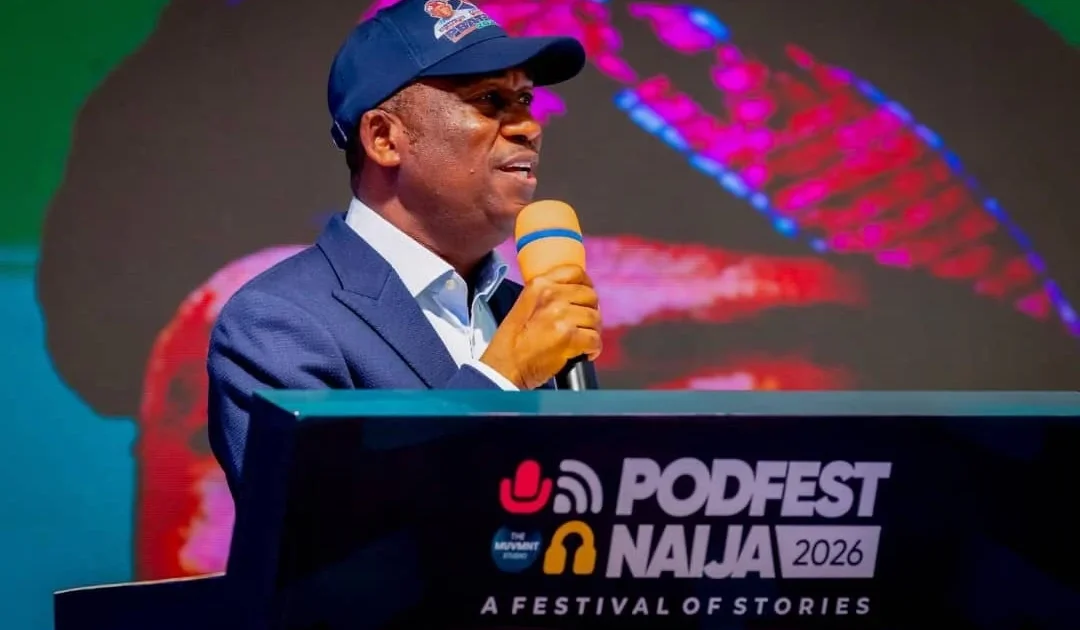
Lagos State Deputy Governor, Obafemi Hamzat, has clarified his remarks on traffic congestion in the state, saying they were taken out of context and misinterpreted on social media. In a video shared on Sunday, Hamzat explained that his comments were made during a speech on storytelling and the creative industry at Podfest Naija 2026. He used Lagos traffic to illustrate how commuters consume podcasts and digital content during their journeys. Hamzat emphasized that his remarks were not about road design or the government's position on congestion.
Hamzat's comments generated criticism on social media, with some users questioning the state's approach to congestion. He quoted himself as saying, "Anyone who has crossed Third Mainland Bridge at 6pm going from VI to Mainland knows that Lagos traffic is not just a problem, it is becoming our lifestyle." The deputy governor defended his statement, saying it was meant to illustrate the relationship between traffic, commuters, and content consumption. He questioned how his remarks were linked to criticisms of the state's handling of traffic.
Tech entrepreneur Tayo Oviosu and former governorship candidate Gbadebo Rhodes-Vivour criticized Hamzat's comments. Oviosu stated that "Lagos traffic is caused by poor road design, not economic activities," while Rhodes-Vivour said that "traffic in Lagos should not be tolerated as a lifestyle" and was "a major drain on productivity." Hamzat responded, saying that people on social media do not read what others say, leading to misinterpretation.
Hamzat decided to publicly explain his remarks to provide context. He emphasized that his comments were not a celebration of traffic congestion or an indication that the state government was comfortable with the inconvenience experienced by residents. The deputy governor's remarks were about acknowledging the realities of a rapidly growing megacity while working to improve mobility.
Olusesan Daini, Director of the New Media Directorate for the joint PBAT-KOH Lagos State Campaign Council, also defended Hamzat. Daini stated that Hamzat's comments were deliberately taken out of context and that the deputy governor was explaining how traffic shaped the daily routines of Lagos residents. Daini cited the government's transport initiatives, including rail and water transportation, road construction, and intelligent traffic management systems.
Daini further emphasized that recognizing traffic as part of daily life is not the same as accepting it as ideal. He stated that public discourse is best served when statements are presented in their full context rather than through selective excerpts. The government's efforts to improve mobility and reduce congestion were highlighted as ongoing.
The controversy surrounding Hamzat's comments highlights the challenges of communication in the digital age. The deputy governor's clarification aims to provide a clearer understanding of his remarks, but the debate on Lagos' traffic congestion and the government's approach is ongoing. Key initiatives and efforts to address the issue will likely continue to be a topic of discussion.
Key points
- Hamzat's comments were taken out of context and misinterpreted on social media.
- The deputy governor's remarks were about illustrating the relationship between traffic, commuters, and content consumption.
- The government is working continuously to improve mobility and reduce congestion in Lagos.