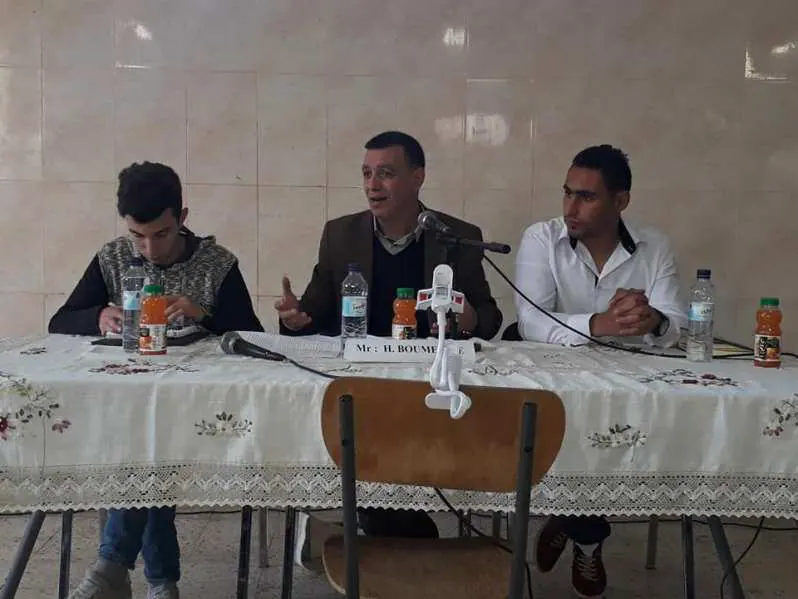
Algerian activist Hamou Boumedine recently shared his insights on the 1980 April movement, a pivotal event in the country's struggle for identity and democracy. According to Boumedine, the movement was not just a contestation, but a comprehensive movement with political, cultural, and identity-related implications. It was primarily a fight against cultural and identity-related domination, which was deeply rooted in an Arab-Muslim environment that dominated Algerian society.
The 1980 movement was initially driven by elites through cultural circles at the university level and groups in Paris. It later gained popular support, led by a certain elite. Boumedine notes that this is in contrast to the current movement, which lacks a clear political project and defined goals. While there is extraordinary mobilization, with millions of people marching together, the movement struggles to find a concrete form of representation.
Boumedine highlights that one of the key differences between the 1980 movement and the current one is the presence of a well-defined political project in the former. The 1980 movement had a clear vision, with much reflection and planning beforehand, involving various struggles from unions, students, and popular movements. This allowed the movement to crystallize and articulate its values, including a demand for democracy and freedom of expression.
The 1980 movement fought against political domination, which was established after 1962, following a transition from a pluralistic system to a dictatorship under leaders such as Benbella and Boumediene. The movement promoted a paradigm of struggle for democracy and freedom of expression, with slogans that were highly politicized and focused on democratic demands, conscience, and individual and collective liberties.
Boumedine emphasizes that the movement was not only about identity-related claims but also about universal values that should be integrated into the democratization and political pluralism process. He notes that one similarity between the 1980 movement and the current one is the use of peaceful combat, which can be considered an achievement of the 1980 movement.
Looking to the future, Boumedine believes that a new model must be proposed, one that integrates Algeria's specificities. He argues that the current state-nation system is unable to respond to the country's diversity and that a more suitable system, such as autonomy for regions or a federal system, is needed.
Boumedine concludes that only a refoundation of the state can allow for the full recognition of Berber identity and linguistic questions. He stresses that the Kabylie region has its own specificities, and the state must adapt to this reality.
Key points
- The 1980 April movement in Algeria was a fight against cultural and identity-related domination.
- The movement promoted a paradigm of struggle for democracy and freedom of expression.
- A refoundation of the state is necessary for the recognition of Berber identity and linguistic questions.