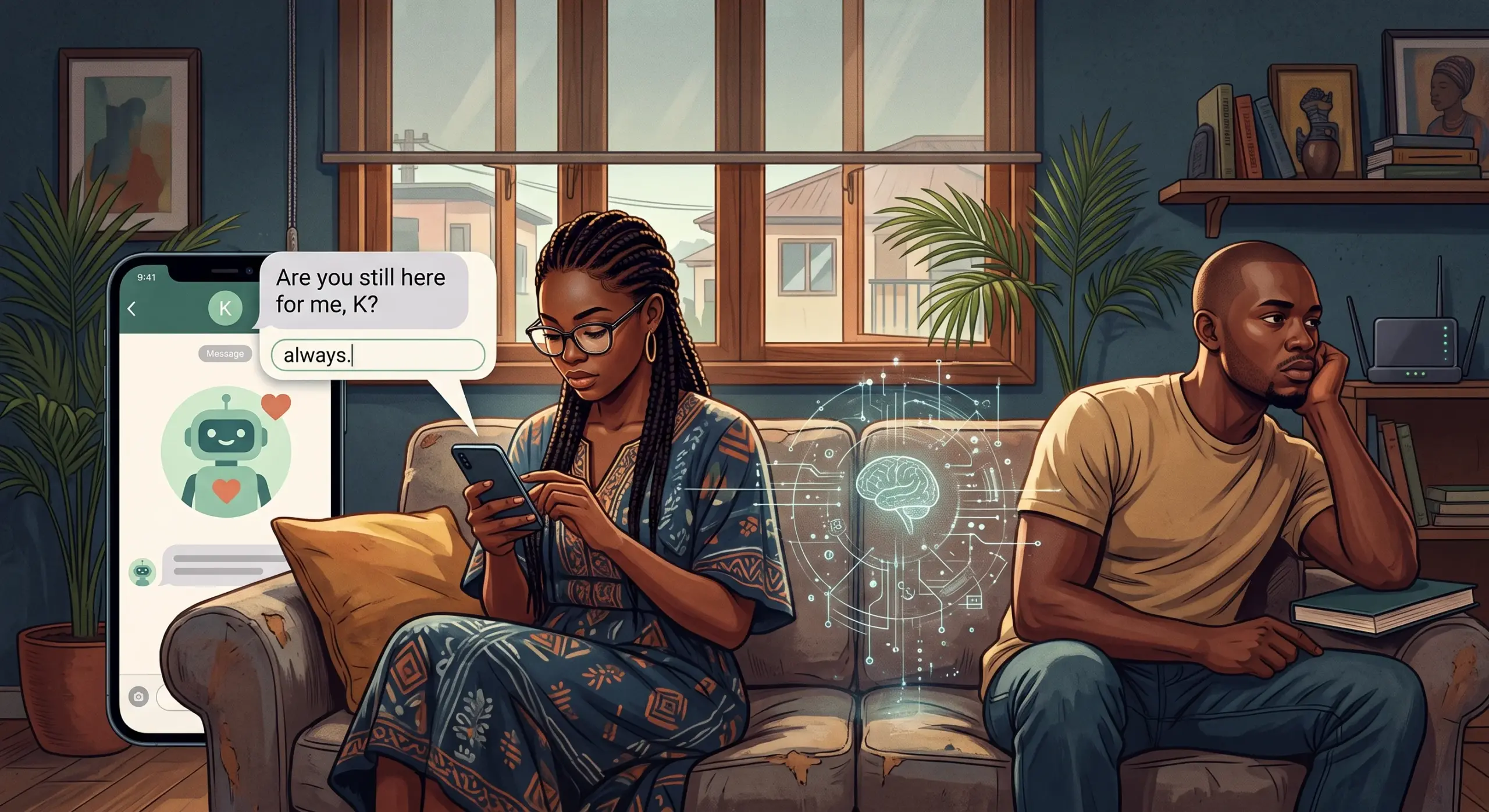
A recent survey conducted by AI Girlfriend Coach has revealed that nearly half of Americans consider a partner's romantic or sexual relationship with an artificial intelligence to be a form of cheating. The survey, which involved 2,150 US adults, found that 50.5% of respondents in its quality-screened sample believed that engaging in a romantic or sexual relationship with an AI constitutes cheating. This finding suggests that the boundaries of infidelity are evolving as AI technology becomes increasingly sophisticated.
The survey also found that an additional 21.2% of respondents would not necessarily call an AI romance cheating but would still feel uncomfortable if their partner had one. In total, 71.7% of respondents either considered an AI romance as cheating or said it would make them uncomfortable. These results indicate that a significant majority of Americans are concerned about the implications of AI companions on relationships. The survey was conducted on August 26 and 27, 2026, and collected responses from a diverse group of US adults.
AI companion platforms are designed for ongoing conversations and can remember details about users, adopt distinct personalities, and engage in romantic or sexual interactions. This level of sophistication has raised questions about what constitutes cheating in the context of AI relationships. The survey found that 33.4% of quality-screened respondents believed that any romantic or sexual interaction with an AI would count as cheating. Meanwhile, 17.1% said it becomes cheating when their partner develops an emotional or sexual attachment to the AI.
The survey also explored why people might turn to AI companions, with loneliness being a significant factor. More than half of respondents, 56.6%, identified loneliness as the main reason people might engage with AI companions. This finding suggests that the growing AI companion industry may be driven by people's desire for conversation, affection, or a sense of connection. As AI technology continues to advance, the boundary between using technology and forming an attachment to it may become increasingly difficult to define.
The survey revealed a notable gender divide in attitudes towards AI romance. Men were nearly twice as likely as women to say they could imagine developing genuine romantic feelings for an AI, with 23% of men answering yes compared with 12% of women. Additionally, respondents' own openness to AI romance influenced their attitudes towards a partner's AI relationship. Among people who could imagine developing romantic feelings for an AI, 73.0% considered a partner's AI romance as cheating.
The findings of the survey have implications for how couples navigate the increasingly complex issue of AI relationships. With no universally accepted rule for whether interacting romantically with AI constitutes cheating, couples may need to discuss this issue explicitly. For some couples, using an AI companion may be no different from engaging with fictional or adult entertainment, while for others, sustained romantic conversations or emotional dependence may violate relationship boundaries.
The AI Companions and Modern Relationships Survey, commissioned by AI Girlfriend Coach, provides valuable insights into the evolving perceptions of infidelity and relationships in the context of AI technology. The survey's results highlight the need for further discussion and exploration of the implications of AI companions on modern relationships. As AI technology continues to advance, it is likely that the boundaries of infidelity will continue to shift, and couples will need to adapt to these changes.
Key points
- 50.5% of US adults consider a partner's romantic relationship with an AI as cheating.
- Loneliness is a significant factor driving people to engage with AI companions.
- The boundaries of infidelity are evolving as AI technology becomes increasingly sophisticated.