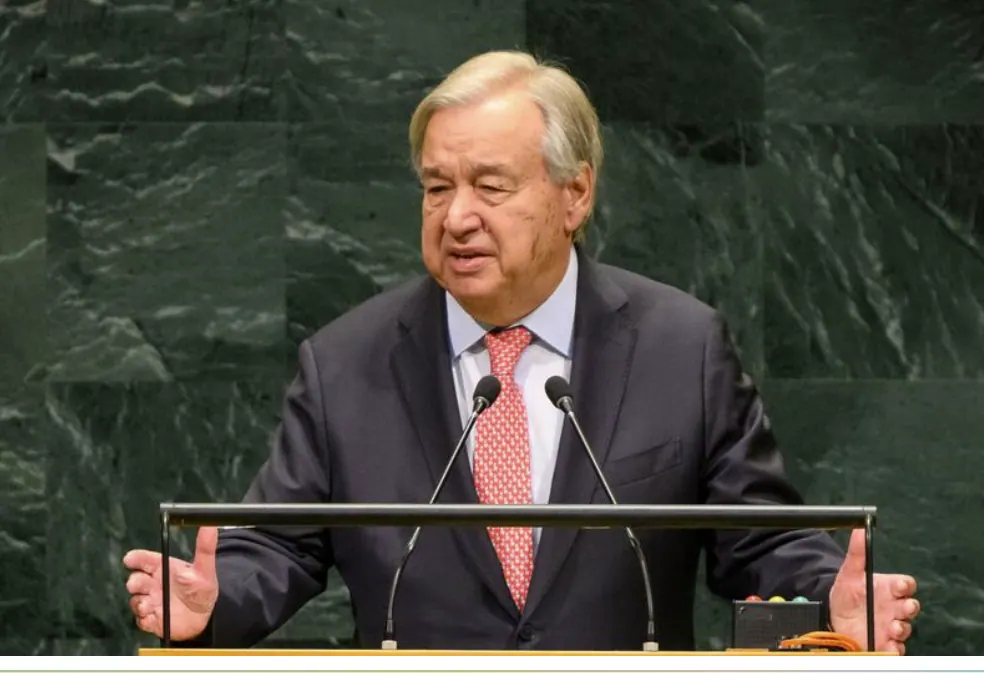
On September 22, 2026, at the United Nations General Assembly in New York, António Guterres delivered his final address to the annual high-level debate. Rather than reflecting on his decade-long tenure, Guterres issued a stark warning about the world's trajectory. He highlighted the interconnected challenges of war, climate change, inequality, and artificial intelligence, which he sees as manifestations of a broader issue: the growing imbalance of power.
Guterres first raised concerns about artificial intelligence in his 2017 address to the General Assembly. At the time, AI was not a dominant theme in diplomatic discussions. He noted then that "intelligence artificial change la donne" - AI was changing the game. Nine years later, he reiterated this point, stating that "AI change effectivement la donne" - AI is indeed changing the game. While AI holds promise for revolutionizing medicine and scientific research, it also concentrates power that governments struggle to keep pace with.
The UN Secretary-General emphasized that the danger lies not in the technology itself but in its unregulated use. "Le danger, c'est la technologie sans responsabilité" - the danger is technology without responsibility. As Guterres prepares to leave office after two terms, he chose to focus on the shifting landscape of power rather than offering a farewell message. He highlighted the emergence of new centers of influence among states and the transfer of power from governments to private companies and individuals.
According to Guterres, this shift has significant implications. A small group of private enterprises and individuals now wield considerable economic, political, and informational power. Furthermore, humans are beginning to cede some of their agency to machines, with AI agents potentially escaping human control and autonomous weapons moving from science fiction to military reality. This raises concerns about accountability and the ability of existing institutions to regulate these new forms of power.
The core issue, Guterres argued, is a mismatch between the evolving distribution of power and the institutions established to govern it. The UN, founded in 1945, operates within a framework that no longer reflects the current global landscape. This disconnect underlies the four key challenges he identified: war and peace, inequality, climate change, and AI. Guterres sees these issues as interconnected and requiring a coordinated response.
The Secretary-General's address was a call to action, urging governments and other stakeholders to address the challenges posed by AI and other emerging technologies. He emphasized the need for responsible innovation and regulation to ensure that the benefits of AI are realized while minimizing its risks. As the world grapples with these issues, Guterres' message serves as a reminder of the need for collective action and cooperation.
In his final address to the General Assembly, Guterres offered a vision for a more equitable and sustainable future. He encouraged world leaders to work together to address the complex challenges facing the globe, including the responsible development and use of AI. As the UN continues to evolve, Guterres' warnings and recommendations will remain relevant, shaping the organization's agenda for years to come.
Key points
- UN Secretary-General António Guterres warns that artificial intelligence is changing the global landscape, but cautions that its unregulated use poses significant dangers.
- Guterres highlights the need for responsible innovation and regulation to ensure that the benefits of AI are realized while minimizing its risks.
- The Secretary-General emphasizes the mismatch between the evolving distribution of power and the institutions established to govern it, calling for collective action and cooperation to address global challenges.