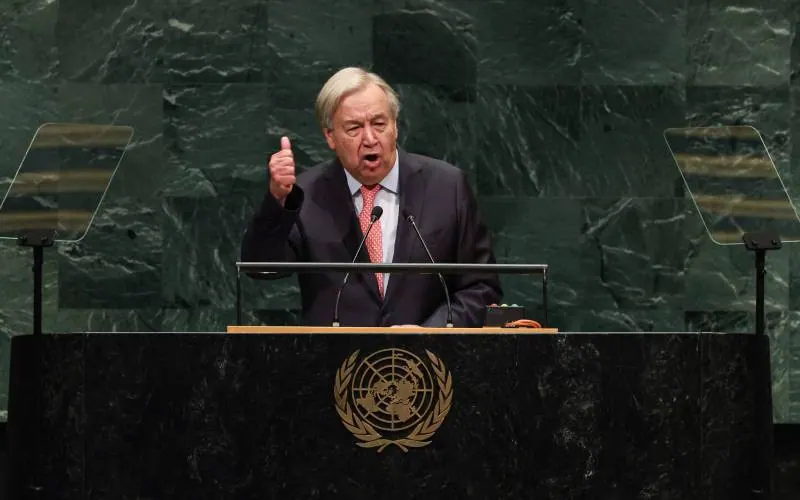
United Nations Secretary-General António Guterres has highlighted the growing influence of artificial intelligence (AI), warning that it is becoming a new test of power in an increasingly interconnected world. Speaking during the United Nations General Assembly in New York, Guterres noted that power was increasingly derived from data, computing capacity and algorithms, unlike in the past when it was largely based on territory, industry and finance.
Guterres said this new form of power was highly concentrated and advancing at extraordinary speed, outpacing humanity’s ability to fully understand its consequences. He recalled his 2017 address to the General Assembly, where he warned that artificial intelligence is a game changer that can boost investment and spectacularly transform lives, but may also have a dramatic impact on the labour market, global security and the very fabric of societies.
A decade later, Guterres emphasized that the danger was not AI or technology itself, but the development of powerful capabilities without adequate oversight, accountability and transparency. He stressed that governments must protect their citizens by sharing information on safety risks, cooperating on testing and evaluation, and working towards common safeguards.
This call for action follows the adoption by UN member states of global principles for AI governance aimed at ensuring that policymaking is guided by evidence. Guterres noted that a growing number of those building AI are sounding the alarm, warning that development is racing ahead of understanding of the risks, and that some call for a pause or guardrails.
Guterres called for responsible pacing in the development of AI, additional safeguards to address emerging risks and a multilateral framework for AI risk management backed by credible and independent oversight. He emphasized that all countries should be included in shaping the rules governing the technology, stating that “AI must be shaped by humanity, with humanity and for all humanity.”
The Secretary-General also warned against the use of children as test subjects for unregulated systems and stressed that life-and-death decisions should never be surrendered to machines. He said, “As we confront the challenges ahead, let us not retreat from these fundamental principles. With one voice, children must never become test subjects for unregulated systems. And let us resolve that life-and-death decisions must not be surrendered to machines. Killer robots must have no place in our future.”
His remarks come as countries develop data centres and national AI policies to guide the use of the technology within their jurisdictions. While AI has the potential to complement human work and drive innovation, its misuse could have serious consequences, underscoring the need for governments to develop appropriate safeguards and public accountability mechanisms.
Key points
- UN Secretary-General António Guterres warns of the growing influence of artificial intelligence.
- Guterres calls for responsible pacing in AI development and additional safeguards.
- The Secretary-General emphasizes the need for a multilateral framework for AI risk management.