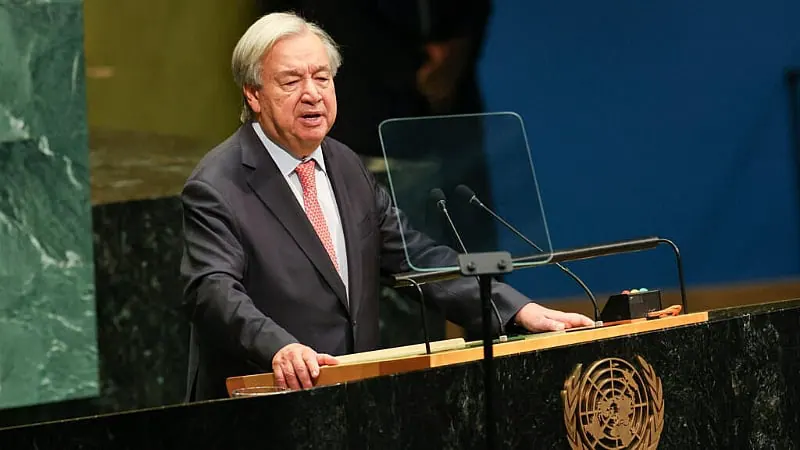
United Nations Secretary-General Antonio Guterres delivered his final address to the 81st UN General Assembly, urging global leaders to respond to the defining challenges of the era. He emphasized the need for cooperation to tackle existential threats such as climate crisis, artificial intelligence, and intensifying inequalities. Guterres warned that the world is at a crossroads, with the choice being between continued fragmentation and collaborative problem-solving.
Guterres has long advocated for cooperation and shared decision-making in the face of accelerating global challenges. He cited raging wars, rising temperatures, and artificial intelligence as pressing concerns. The UN leader called for a world built on interdependence, sustained by economic, political, social, and technological connections. This message took on added urgency as Guterres prepares to leave office at the end of the year.
The UN Secretary-General rebuked the notion that might makes right, telling superpowers to recognize that their power is not absolute. He noted that military power alone cannot secure peace, citing recent years as evidence. Guterres' speech opened the main portion of the world's largest diplomatic meeting of the year, where leaders from the UN's 193 member countries will address each other and air their hopes, plans, and grievances.
US President Donald Trump offered a contrasting view of power, touting his country's economic, technological, and military strength. He reiterated his criticism of the UN, saying it has "great potential" but is hindered by what he called a "far-left agenda of globalist bureaucrats." Trump also criticized the International Criminal Court, to which the US is not a party.
The annual high-level gathering at the UN General Assembly will focus on several pressing issues, including wars in Ukraine, Sudan, DR Congo, and Myanmar, as well as the rise of global warming and growing inequalities. The future of the United Nations itself will also be on the agenda, with discussions on reforming key institutions such as the UN Security Council. Member nations have agreed to a wide-ranging reform package, but implementation is proving challenging.
Behind the scenes, speculation is growing about who will succeed Guterres as UN Secretary-General. His second five-year term ends on December 31, and no clear successor has emerged. Guterres closed his speech by acknowledging his departure and vowing to continue championing the values of the UN. He received a sustained standing ovation from the assembly.
The UN General Assembly will feature speeches from around 130 heads of state and government, including French President Emmanuel Macron and Ukrainian President Volodymyr Zelensky. Notably, Chinese President Xi Jinping and Russian President Vladimir Putin will not attend, while Indian Prime Minister Narendra Modi has also backed out. The US has denied Palestinian leader Mahmoud Abbas a visa, prompting him to address the assembly via video instead.
Key points
- Guterres calls for a world built on interdependence to tackle global challenges.
- The UN faces pressing issues, including wars, climate crisis, and artificial intelligence.
- The future of the United Nations and its reform will be discussed at the General Assembly.