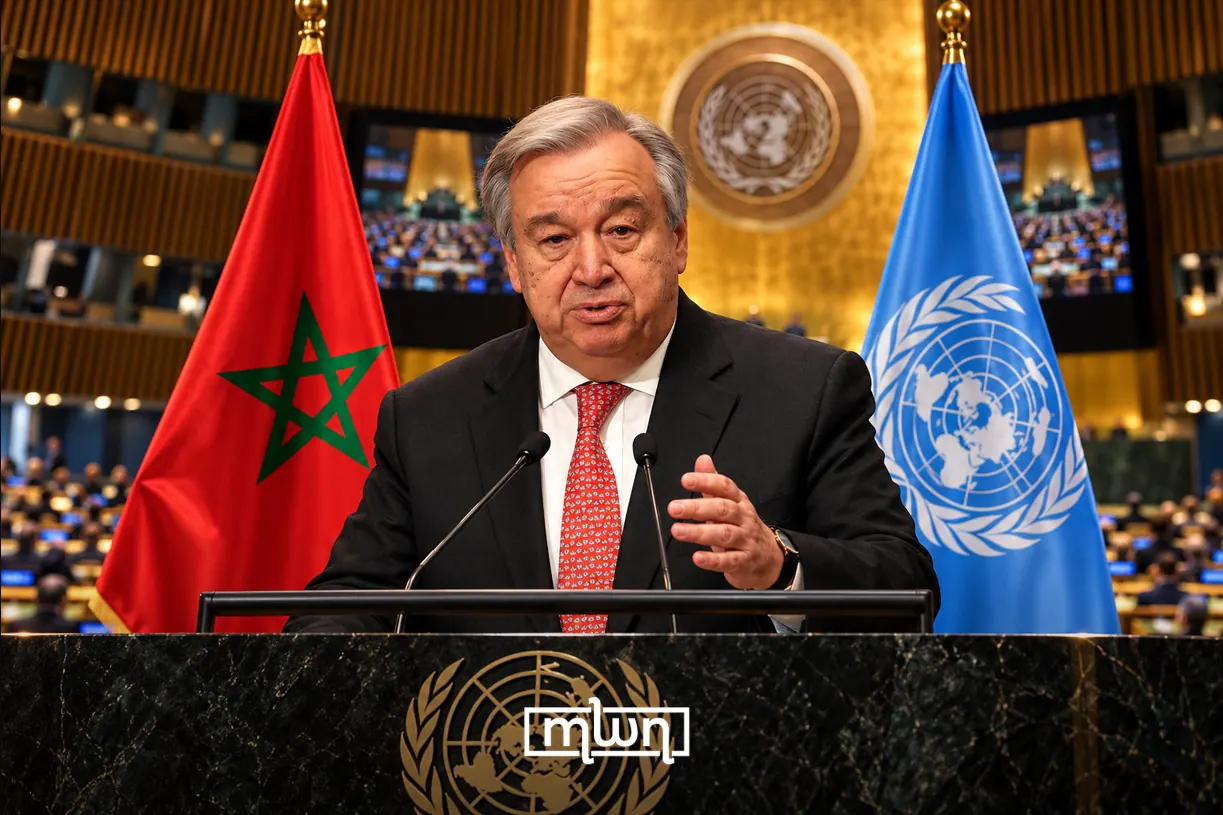
The UN Secretary-General's report on Western Sahara, dated October 1, has been submitted to the Security Council, revealing a proposed transitional council as a central element in Morocco's autonomy plan for the disputed territory. This development comes as the Security Council prepares to discuss the future of the peacekeeping mission, MINURSO, whose mandate expires on October 31. The report covers a full year under Resolution 2797, adopted in October 2025, which consecrated Morocco's autonomy initiative as the basis for negotiations.
The report highlights a significant shift in the talks, with Morocco, the Polisario separatists, Algeria, and Mauritania engaging in direct negotiations for the first time in seven years. Three rounds of talks took place in early 2026, co-chaired by Staffan de Mistura, the UN Secretary-General's Personal Envoy for Western Sahara, and Michael G. Waltz, the US Permanent Representative to the United Nations. The negotiations built on Morocco's autonomy proposal, as per Resolution 2797, and explored the creation of a transitional council to manage the transition towards autonomy.
The transitional council was examined in-depth during the second round of talks in Madrid, where participants discussed its role in managing transitional processes and providing a space for negotiations on a just, durable, and mutually acceptable solution. The talks also touched on resource-sharing, amnesty and reconciliation, disarmament, demobilization, and reintegration, security measures, and electoral systems. Mauritania, which has been less involved in the talks, proposed the establishment of a commission to clarify the definitive and permanent international borders of the territory.
Following the Madrid round, UN and US teams worked together to draft a preliminary framework agreement covering a possible transition phase, including compromise positions on the areas discussed. The draft was presented during the third round of talks in Washington, where the transitional council was again a key topic. However, the talks hit a limit when debating self-determination and sovereignty over the territory, with wide divergences between the parties.
The co-chairs decided to handle the contentious issues of self-determination and sovereignty with each party separately, leading to a series of bilateral meetings between de Mistura and the parties. De Mistura met with the Polisario in Brussels, Algeria in Brussels, Morocco in New York, and the Polisario leadership in Tindouf, as well as with Algeria's foreign minister and the president of Mauritania. These consultations led to a revised draft framework agreement for a transition period.
The report concludes that a framework agreement followed by a transition period could serve as the basis for negotiations on a detailed model of self-governance for the territory and a meaningful process of consultation with the population. Guterres emphasizes that this arrangement is the most likely to let negotiations proceed in the best possible conditions. The report also notes that Morocco entered the talks with a developed version of its 2007 plan and a "Draft Autonomy Statute," which was not made public.
The international community has shown support for Morocco's autonomy plan, with the European Union updating its common position in January to state that negotiations should take Morocco's proposal as their base. Several countries, including Sweden, Switzerland, Madagascar, Canada, and Japan, have reaffirmed their support for the plan, while Mali and Honduras have suspended their recognition of the self-declared "SADR." On the humanitarian front, de Mistura and the UN refugee agency proposed voluntary "go and see" visits for Tindouf refugees to Laayoune and Dakhla.
Key points
- The UN report reveals a proposed transitional council as a central element in Morocco's autonomy plan for Western Sahara.
- The talks between Morocco, the Polisario separatists, Algeria, and Mauritania have made progress, but significant challenges remain.
- The international community has shown support for Morocco's autonomy plan, with several countries reaffirming their backing for the proposal.