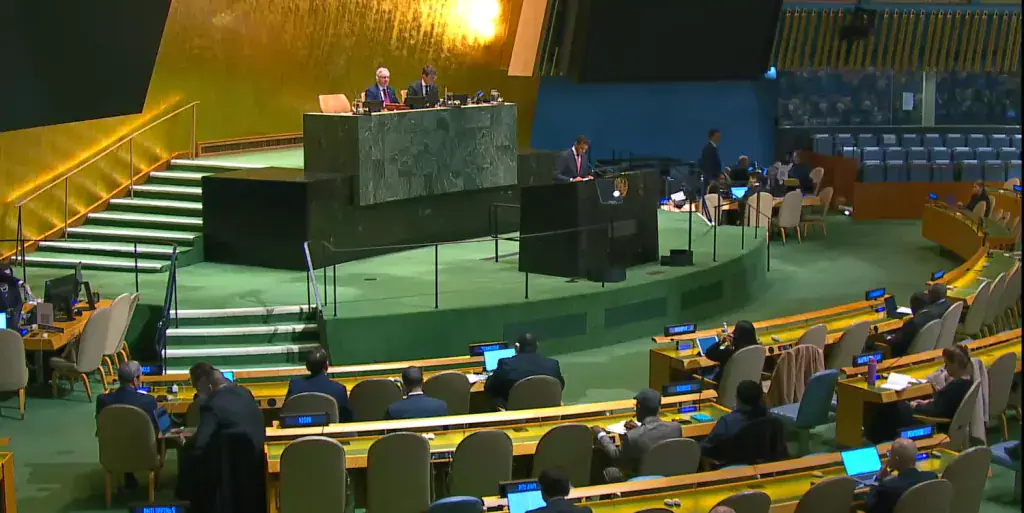
Gulf Arab states have reiterated their support for Morocco's Autonomy Plan as a realistic framework for resolving the Western Sahara dispute. Speaking on behalf of the six-member Gulf Cooperation Council (GCC), Bahrain's representative Jamal Fares Alrowaiei stated the group's position in support of Morocco's sovereignty and territorial integrity. The GCC welcomed Security Council Resolution 2797, which identifies Morocco's Autonomy Plan as a basis for negotiations.
The statement was made during a United Nations General Assembly debate following Russia's veto of a US-drafted Security Council resolution on the renewal of the mandate of the United Nations Mission for the Referendum in Western Sahara (MINURSO). The GCC representative said the group supported international efforts to reach a political solution that would strengthen regional security and stability while creating opportunities for greater cooperation and development.
Alrowaiei referred to the final communiqué of the GCC's 46th summit, held in Bahrain in December 2025, which reaffirmed the group's position on the Western Sahara issue. The GCC comprises Bahrain, Saudi Arabia, the United Arab Emirates, Kuwait, Oman, and Qatar. Bahrain also welcomed Morocco's commitment to the ceasefire and its cooperation with the United Nations during MINURSO's liquidation process.
Speaking separately on behalf of Bahrain, Alrowaiei said the country had voted in favor of the US-drafted resolution, motivated by its desire to build upon the progress achieved through Security Council Resolution 2797. This resolution was seen as an important step in consolidating the Moroccan Autonomy Initiative as the basis for negotiations aimed at reaching a mutually acceptable and lasting political solution.
The Security Council considered two competing draft resolutions on October 30, but neither was adopted due to vetoes. The US proposal, which would have dropped the referendum reference in MINURSO and extended its mandate for another 12 months, was blocked by Russia's veto. Russia then proposed a one-year technical extension of MINURSO's existing mandate, but the US veto blocked that proposal, causing MINURSO's mandate to expire on October 31.
Morocco welcomed the non-renewal of MINURSO's mandate, with the Royal Office reaffirming the country's commitment to the ceasefire as a voluntary commitment that would not change with MINURSO's departure. The King instructed the Interior Ministry's Office for Coordination with MINURSO to oversee and support the mission's liquidation and withdrawal in cooperation with the United Nations.
Alrowaiei also addressed the humanitarian situation in the Tindouf refugee camps, calling for stronger international efforts to find sustainable solutions that protect the dignity, rights, and choices of the people living there. Bahrain's representative emphasized the importance of addressing the humanitarian situation and ensuring that those concerned could benefit from lasting solutions.
Key points
- Gulf Arab states support Morocco's Autonomy Plan as basis for resolving Western Sahara dispute.
- Russia's veto blocked US-drafted Security Council resolution on MINURSO mandate renewal.
- Morocco welcomes non-renewal of MINURSO's mandate, reaffirms commitment to ceasefire.
Reporting sources
- Read article: Gulf States Back Morocco’s Autonomy Plan at UN Debate on Sahara Veto · Morocco World News