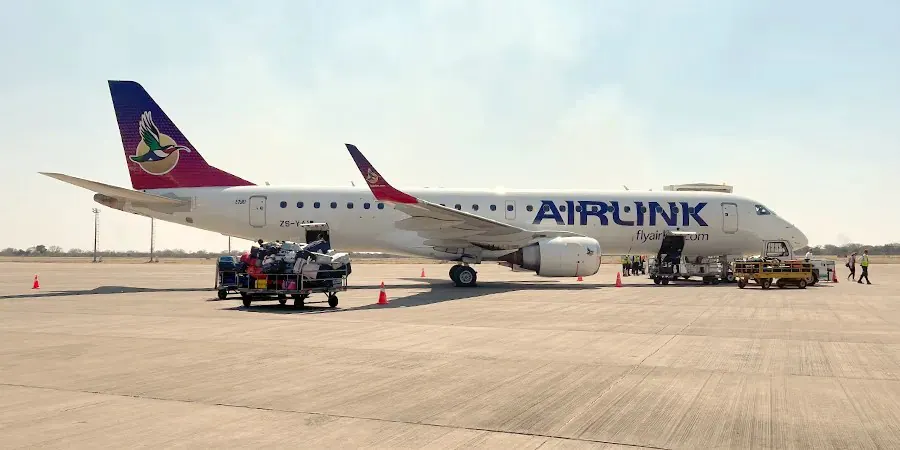
Airlink Africa's expansion, supported by Qatar Airways' capital and new Embraer jets, is transforming regional connectivity across sub-Saharan Africa. This development signals fresh opportunities for investors tracking Gulf-funded infrastructure projects on the continent. The airline plans to grow its network by approximately 10% and enter two additional countries, increasing its total country presence from 16 to 18.
The growth is driven by Gulf airline capital, with Qatar Airways holding a strategic stake in Airlink. This partnership provides the South African carrier with financial firepower and access to international marketing reach beyond its balance sheet. According to a senior analyst, Airlink is converting Gulf airline capital into African network density faster than any comparable regional operator.
Airlink's aircraft of choice for this expansion is the Embraer E195-E2, which has 124 seats and is suited for African city pairs with real but limited demand. This model allows for incremental route-opening while avoiding the risk of over-capacity on thin corridors. As of late 2024, Airlink served 67 destinations across 16 countries, with the two new country entries expected to raise that count to 18.
The airline's management has not yet disclosed the target markets for its new routes, citing that the timing depends on aircraft deliveries, regulatory approvals, and route economics. However, the direction is clear: Airlink is focused on building network density rather than chasing single high-profile routes. This strategy is disciplined, given the wide connectivity gaps that remain on the continent.
A recent schedule addition demonstrates the strategy's success: on 2 October 2024, Airlink launched a twice-weekly nonstop service between Cape Town and Mauritius using the 124-seat E195-E2. The direct link strengthens Cape Town's appeal to Indian Ocean leisure and business travellers and marks Airlink's first entry into the Mauritius market.
This move signals that the carrier is prepared to compete on international leisure routes, not just short regional hops. For executives in southern and east Africa, it suggests that more direct corridors could follow. The partnership with Qatar Airways fits a well-established pattern of Gulf sovereign and airline capital moving into African infrastructure across aviation, ports, and logistics over the past decade.
The Airlink investment extends Qatar's footprint into sub-regional markets beyond its own long-haul network. The structure benefits both parties, with Airlink gaining a global alliance partner and capital, and Qatar gaining exposure to high-growth African aviation traffic at the regional level. Together, they serve routes that were previously underserved.
Key points
- Airlink's expansion is backed by Qatar Airways' capital and new Embraer jets.
- The airline plans to grow its network by approximately 10% and enter two additional countries.
- The partnership with Qatar Airways provides Airlink with financial firepower and access to international marketing reach.