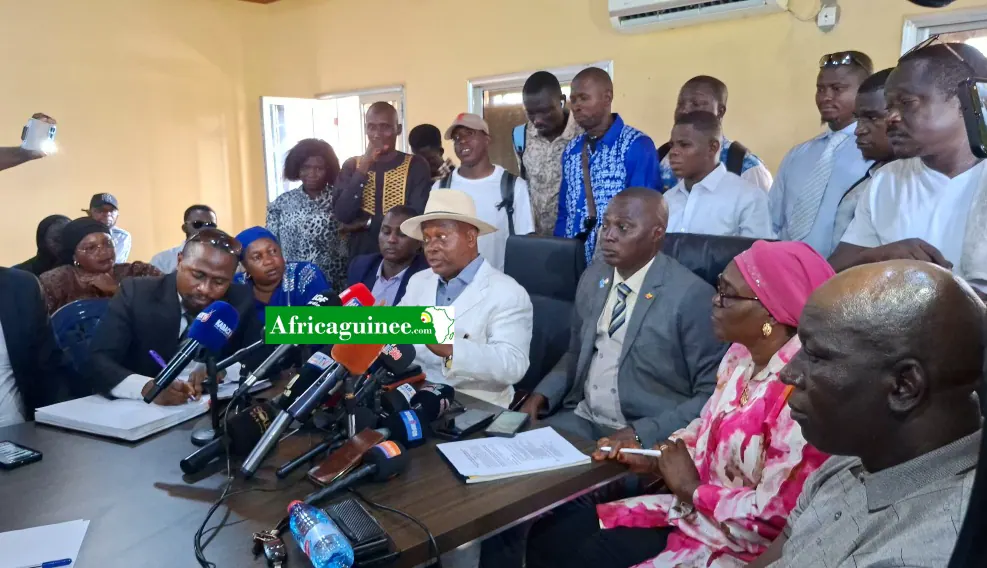
The Guinean education sector is bracing for another crisis as teachers' unions have raised concerns over the government's failure to meet their demands. In a press conference held on September 21, 2026, union leaders denounced the violation of agreements signed with the government and threatened to disrupt the upcoming school year. The unions are demanding priority for contract teachers who have completed a practical evaluation.
The dispute centers on Article 7 of a tripartite agreement signed on January 3, 2026, between the unions, the government, and the National Social Dialogue Council. The article stipulates that contract teachers who have passed a practical evaluation should be prioritized in upcoming state recruitment. Union leaders argue that these teachers have already completed necessary steps, including registration, biometric identification, and practical exams.
Kadiatou Bah, Secretary-General of the SLECG, emphasized that the unions are not seeking new procedures or commissions but rather the recognition of the contract teachers' acquired rights. She noted that in Guinea, contract teachers with years of experience are often required to undergo additional evaluations, whereas in other countries, they are directly integrated into the education system.
The Intersyndicale, a coalition of teachers' unions, has presented a comprehensive list of demands. These include the immediate payment of salaries withheld since 2023, regularization of the administrative situation of teachers who have completed further education, and direct engagement of contract teachers without new competitive exams. The unions also seek a re-examination of cases of teachers who were initially rejected.
The unions highlighted that in 2024, out of 14,500 contract teachers identified and evaluated by the state, only 10,000 were retained, leaving 4,500 without positions. Michel Pépé Balamou, Secretary-General of the SNE, emphasized the need for the government to address these issues. Aboubacar Soumah, president of the SLECG, warned that if the government's commitments are not met, there will be no peaceful school year.
The unions have accused the government of violating the January 3 agreement and called on the authorities to take responsibility. Soumah emphasized that the government, as the guarantor of social climate, must ensure that its commitments are respected. The unions have exhausted all amicable avenues and are now threatening strike action.
As the school year approaches, pressure is mounting on the government to resolve the crisis. The situation remains uncertain, with the potential for significant disruptions to the education sector. The government faces a critical challenge in addressing the unions' demands and ensuring a peaceful school year.
Key points
- The Guinean government faces a potential crisis in the education sector as teachers' unions threaten strike action over unmet demands.
- The unions are demanding priority for contract teachers who have completed a practical evaluation and the regularization of their administrative situations.
- The situation remains uncertain, with the potential for significant disruptions to the education sector.