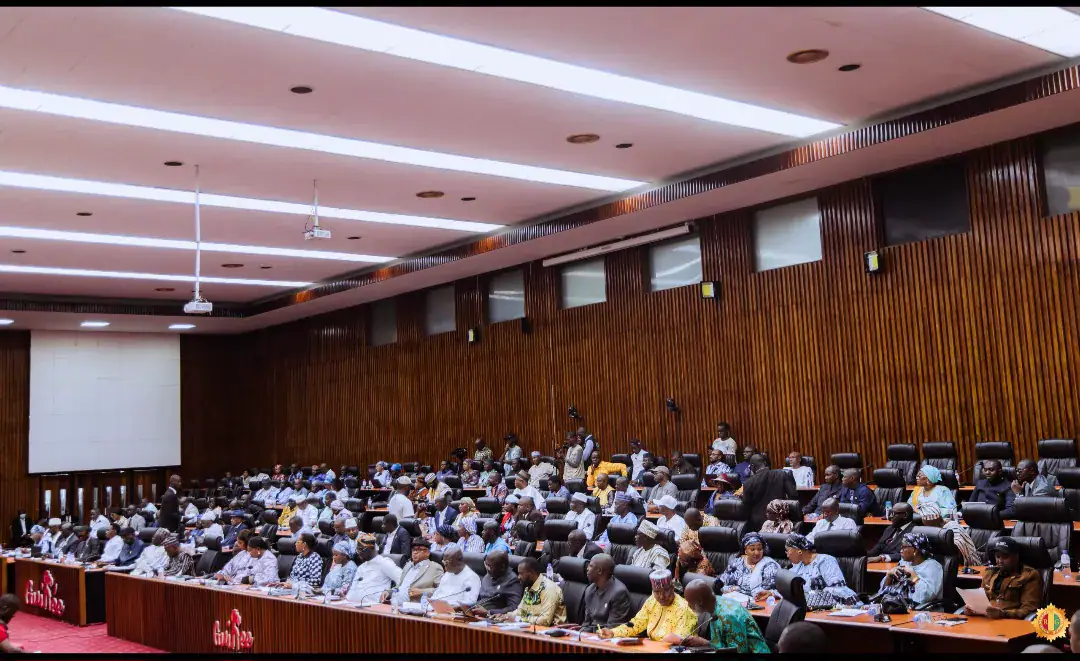
On October 31, 2026, the Guinean National Assembly adopted, in an extraordinary session, the revenue section of the 2026 revised finance bill (PLFR). The revised budget projects revenues of 60,064.47 billion Guinean francs (GNF), up from 55,858.10 billion GNF in the initial 2026 finance law, representing a 7.53% increase. This adjustment is part of the government's new economic and budgetary orientations, including the implementation of the Simandou 2040 program.
The revision takes into account changes in the national and international economic situation. The macroeconomic framework now forecasts an inflation rate of 5.2%, up from 3.5% initially, and a growth target reduced to 8.6% from 9.5%. The nominal GDP is revised downward to 392,503 billion GNF from 401,670 billion GNF. However, the tax pressure is expected to reach 14.23% of GDP, up from 12.13% in initial forecasts. The budget deficit is slightly improved, standing at 2.01% of GDP.
The parliamentary commission's report highlights that the revised finance bill allows the state to adjust to new economic realities. The government submitted the PLFR 2026 to the National Assembly on October 17, 2026, as per the Organic Law on Finance Laws (LORF). The report also notes that the state will maintain fuel prices at 12,000 GNF, resulting in lost oil revenue, and a provision of 913 billion GNF for subsidizing petroleum product prices.
The general budget's revenues are revised upward to 57,664.90 billion GNF, a 7.92% increase. Tax revenues drive this growth, estimated at 52,795.68 billion GNF, up 8.39% from initial forecasts. This increase is mainly due to higher revenues from taxes on goods and services, which rose by 5,248.55 billion GNF (24.20%), and other tax revenues, which increased by 785.79 billion GNF (72.72%).
Conversely, revenues from special allocation budgets (BAS) slightly decrease to 2,399.57 billion GNF, down 1.10% from initial projections. The National Development Fund (FNDL) and the Mining Investment Fund (FIM) experience declines, while the Conakry Commune Development Fund (FODECCON) sees its resources increase. The report also mentions that the Assembly urged financial administrations to broaden the tax base and identify new revenue sources.
The parliamentary commission also raised concerns about the cost of tax expenditures, particularly exemptions and special regimes in the mining sector and other areas. In 2025, customs tax expenditures were estimated at 11,793 billion GNF, equivalent to 48% of total customs revenue. The Assembly called on the government to take measures to ensure the effective application of fiscal taxes, including those on games of chance.
The Assembly also addressed the issue of taxing games of chance. According to the report, two levies were introduced during the examination of the 2025 budget: a 15% tax on gross gaming revenue and a 7% levy on benefits exceeding one million GNF. However, the regulatory authority instructed operators not to pay these taxes, a situation deemed contrary to the principle of hierarchy of norms.
Key points
- The Guinean National Assembly adopted a revised 2026 budget revenue framework, increasing projected revenues to 60,064 billion GNF.
- The revised budget takes into account changes in the national and international economic situation, including a higher inflation rate and reduced growth target.
- The Assembly urged financial administrations to broaden the tax base and called on the government to ensure the effective application of fiscal taxes.