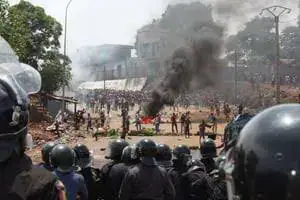
The Guinean opposition, represented by the Collectif des Forces Vives de Guinée (FVG), has strongly condemned the government's response to recent deadly clashes between security forces and artisanal miners in the northeastern region of Siguiri. The clashes, which occurred on November 13, resulted in the deaths of at least 10 people. The FVG described the government's actions as a "meat grinder" approach, stating that it is a sign of an "authoritarian drift" by the junta.
The clashes occurred after the government imposed a total ban on "anarchic and illegal" artisanal mining in the region on November 2. The ban led to the deployment of the army and the expulsion of tens of thousands of West African nationals who had been working in the mines. The FVG stated that the government's decision was taken without prior consultation with the affected populations and without providing alternative solutions for the thousands of people whose livelihoods depend on this activity.
The Guinean government has justified its actions as necessary to regulate mining activities and preserve the environment. However, the FVG argues that these goals cannot be achieved through the use of force and brutality. The collective also rejected the government's claim that the violence was a result of exchanges of fire between protesters and security forces, saying that this narrative is "malhonnete" and aims to shift the blame.
The situation in Guinea has been marked by increased authoritarianism since General Mamadi Doumbouya took power in a coup in September 2021. Doumbouya was elected president in December 2025, but his regime has been criticized for its heavy-handed approach to governance. The FVG is calling for a more inclusive and peaceful approach to addressing the country's challenges.
The artisanal mining sector in Guinea has significant economic and environmental implications. The country is rich in mineral resources, but the exploitation of these resources has led to environmental degradation and pollution. The government's efforts to regulate the sector are seen as necessary, but the FVG argues that these efforts must be balanced with the need to protect the livelihoods of those who depend on the sector.
The international community has been following the situation in Guinea closely, with concerns about the country's democratic trajectory. The Economic Community of West African States (ECOWAS) and other regional organizations have been urging the Guinean government to respect human rights and promote inclusive governance.
The Guinean government's response to the crisis has also sparked concerns about the humanitarian situation in the region. The United Nations and other humanitarian organizations have been providing assistance to those affected by the violence, but the situation remains volatile. The FVG is calling for an immediate end to the violence and for the government to engage in dialogue with the opposition and other stakeholders to find a peaceful solution to the crisis.
Key points
- The Guinean opposition has condemned the government's response to deadly clashes between security forces and artisanal miners, calling it an example of "authoritarian drift".