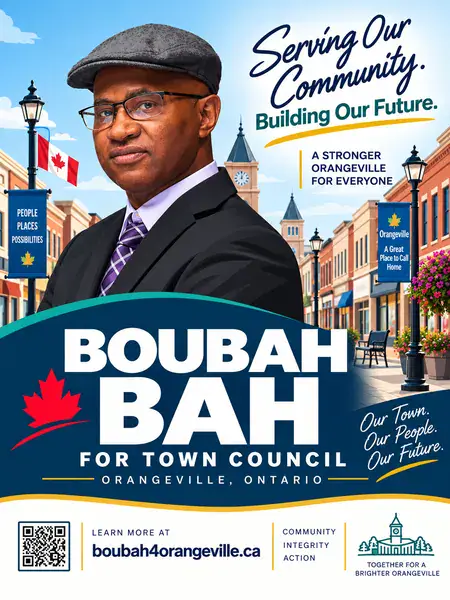
Boubacar Caba Bah, a Guinean, recently participated in the municipal election in Orangeville, Ontario, Canada, as a candidate. He decided to run out of curiosity and to understand the democratic process in Canada. Orangeville is located about 80 kilometers northwest of Toronto. The election took place on a Monday in October, as per Ontario's municipal election schedule, which occurs every four years.
In Ontario, municipal elections determine local representatives who make decisions on various aspects of daily life, including property taxes, housing, transportation, infrastructure, safety, and community services. To run as a candidate, one must submit a nomination, obtain validation from 20 registered voters, and pay a deposit of $100 for councilors or $200 for mayor and deputy mayor. In Orangeville, seven positions were up for election: mayor, deputy mayor, and five councilors.
The election process in Orangeville involves a single-round, first-past-the-post system, where the candidate with the most votes wins. The top five candidates for councilor positions with the most votes are declared elected. The city's officials, under the supervision of the municipal clerk, organize the election and ensure compliance with the Municipal Elections Act. Orangeville is a level of government in Canada's territorial administration system, providing various services to its citizens.
A total of six people, including the incumbent mayor, ran for mayor, two for deputy mayor, and 18 for the five councilor positions. After nominations, the list of candidates is published on the city's website, and candidates are informed about campaign regulations, including strict spending limits and the requirement for a dedicated bank account and audited financial report. Local business groups and charities organize online debates where candidates present their platforms.
Candidates in Orangeville are allowed to install posters in the city 60 days before the election and utilize modern communication tools like social media and websites. Online discussions, sometimes heated due to anonymity, take place on platforms like Facebook, Instagram, and Twitter. Candidates also engage in door-to-door visits to meet voters in person. Boubacar Caba Bah made 5,432 visits, discussing his platform and vision with residents, who were generally very polite.
A major concern for residents was high property taxes compared to the services received. Orangeville, like many rural and suburban municipalities, faces low voter turnout, with about 30% participation in 2022. This year, the introduction of online voting increased participation to 36.45%, but nearly two-thirds of eligible voters did not cast a ballot. The election took place across the province, and Boubacar Caba Bah ranked ninth out of 18 candidates.
Despite not winning, Boubacar Caba Bah received congratulations from many residents, compatriots in Canada and abroad, and even elected officials, who praised his campaign focused on reducing property taxes, improving public transportation, addressing homelessness, enhancing communication, and ensuring safety. While his immediate political goals may not have been achieved, he looks forward to potential future opportunities, with a possible return in 2030.
Key points
- Boubacar Caba Bah participated in Orangeville's municipal election to understand Canada's democratic process.
- The election in Orangeville had a 36.45% voter turnout, with online voting increasing participation.
- Boubacar Caba Bah's campaign focused on reducing property taxes, improving public transportation, and addressing homelessness.