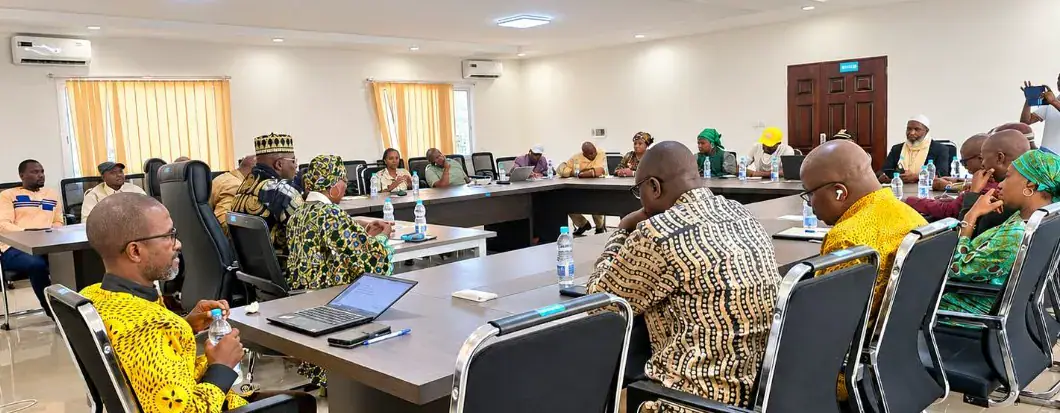
On November 10, 2026, administrative officials from various government departments in Labé, Guinea, gathered for an information session on the upcoming regional and senate elections. The meeting, held at the governors' conference room, was chaired by Regional Governor General Boundouka Condé. The session aimed to educate participants on the organization and selection process of future regional councilors and senators. The discussion was led by jurist Mouley Ismaël Diallo.
During the session, Diallo explained that regional councilors will be selected from among communal councilors. Communes with up to 29 councilors will have one representative, while those with 30-45 councilors can designate two. For senate elections, communal and regional councilors will form the electoral college. Political parties and independent candidates can also submit nominations. Each prefecture will elect one senator. The new Guinean Senate will comprise 87 members, with 58 elected and 29 appointed by the President of the Republic.
According to Diallo, the establishment of regional councils marks a significant step in Guinea's institutional organization. These consultations will enable stakeholders to better understand the functioning of these new institutions. The session drew several high-ranking officials from decentralized government services, including education, housing, and meteorology. The governor's chief of staff and cabinet chief also participated in the discussions.
The initiative is part of the preparations for the upcoming elections, scheduled for November 29 for regional elections and December 20, 2026, for senate elections. This information session is crucial in ensuring that stakeholders are aware of the electoral process and its modalities. By engaging with administrative officials, the government aims to promote transparency and inclusivity in the electoral process.
The Guinean government has been working to strengthen its institutional framework, and the establishment of regional councils and a senate is a key aspect of this effort. The regional councils will play a vital role in decentralizing power and promoting local governance. The senate, on the other hand, will provide representation for the regions at the national level.
The information session in Labé is part of a broader effort to engage with stakeholders across the country. Similar sessions are likely to be held in other regions to ensure that all stakeholders are informed about the electoral process. By doing so, the government aims to promote citizen participation and ensure that the elections are free, fair, and transparent.
The upcoming elections are significant for Guinea's democratic development. The establishment of regional councils and a senate will provide new avenues for citizen representation and participation. As the country prepares for these elections, stakeholders will be watching closely to ensure that the process is transparent, inclusive, and free from irregularities.
Key points
- The Guinean government has scheduled regional elections for November 29 and senate elections for December 20, 2026.
- The new Guinean Senate will comprise 87 members, with 58 elected and 29 appointed by the President of the Republic.
- Regional councilors will be selected from among communal councilors, with communes having up to 29 councilors having one representative.
Reporting sources
- Labé : Les cadres de l’administration informés sur les élections régionales et sénatoriales · Guinean Press Agency