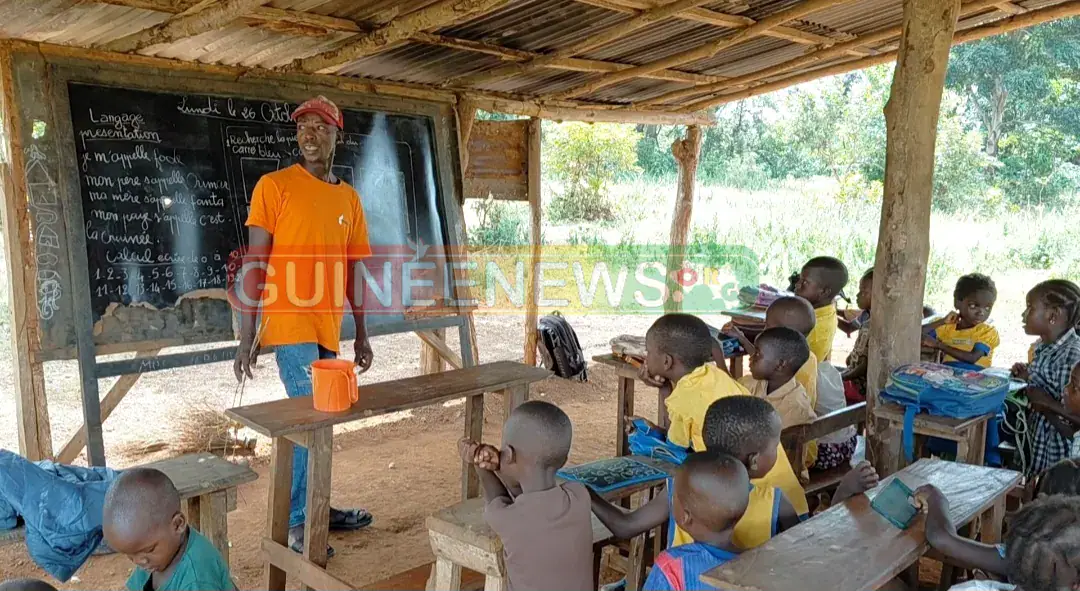
In the village of Sombadé, located in Guinea's Kindia region, a makeshift school built by the community has been in operation for four years. The school, which serves students from Sombadé and surrounding villages, was constructed due to a lack of educational infrastructure in the area. Despite the community's efforts, the school's conditions are far from ideal, with students and teachers facing numerous challenges. The makeshift school is a temporary solution that has become a long-term reality.
The school's makeshift structure, built by the community, serves as a temporary solution for students who would otherwise have no access to education. However, the structure is not equipped to handle the number of students, with 64 students sharing a small space. The lack of tables, chairs, and educational materials further exacerbates the challenges faced by students and teachers. The community's efforts to provide a learning environment have been hindered by a lack of resources and support from authorities.
Kerfalla Cissé, the school's teacher, faces significant challenges in providing quality education to his students. He is responsible for teaching both first and second-year students in a single makeshift classroom, with limited resources and no support staff. The lack of infrastructure and resources forces Cissé to adapt and find ways to manage his classes, despite the difficulties. He expressed concerns about the impact of the makeshift school on students' learning outcomes.
The community's initiative to build the makeshift school was driven by a desire to provide their children with access to education. Mohamed Lamine Souaré, a parent of students at the school, explained that the community came together to build the structure after realizing that their children would otherwise be left without educational opportunities. The community's efforts have ensured that students in Sombadé have access to some form of education, but the situation remains precarious.
Despite the community's efforts, the makeshift school's conditions are far from ideal. Students often attend classes without uniforms, shoes, or necessary educational materials. The school's location also makes it vulnerable to extreme weather conditions, with heavy rainfall and intense sunlight disrupting classes. The community's concerns about the school's conditions have been echoed by students, who are eager for a more suitable learning environment.
Bountouraby Souaré, a second-year student, expressed her frustration with the current state of the school. She called on the government to provide a more suitable learning environment, highlighting the challenges faced by students and teachers. The students' concerns are shared by the community, which is advocating for urgent action from authorities to address the school's infrastructure needs.
The situation in Sombadé highlights the need for urgent action from authorities to address the educational needs of the community. The community's efforts to provide a makeshift school have been commendable, but a more sustainable solution is required to ensure that students have access to quality education. The authorities are urged to provide support and resources to address the school's infrastructure needs and ensure that students in Sombadé have access to a suitable learning environment.
Key points
- The community-built makeshift school in Sombadé, Guinea, has been in operation for four years, despite lacking basic infrastructure and resources.