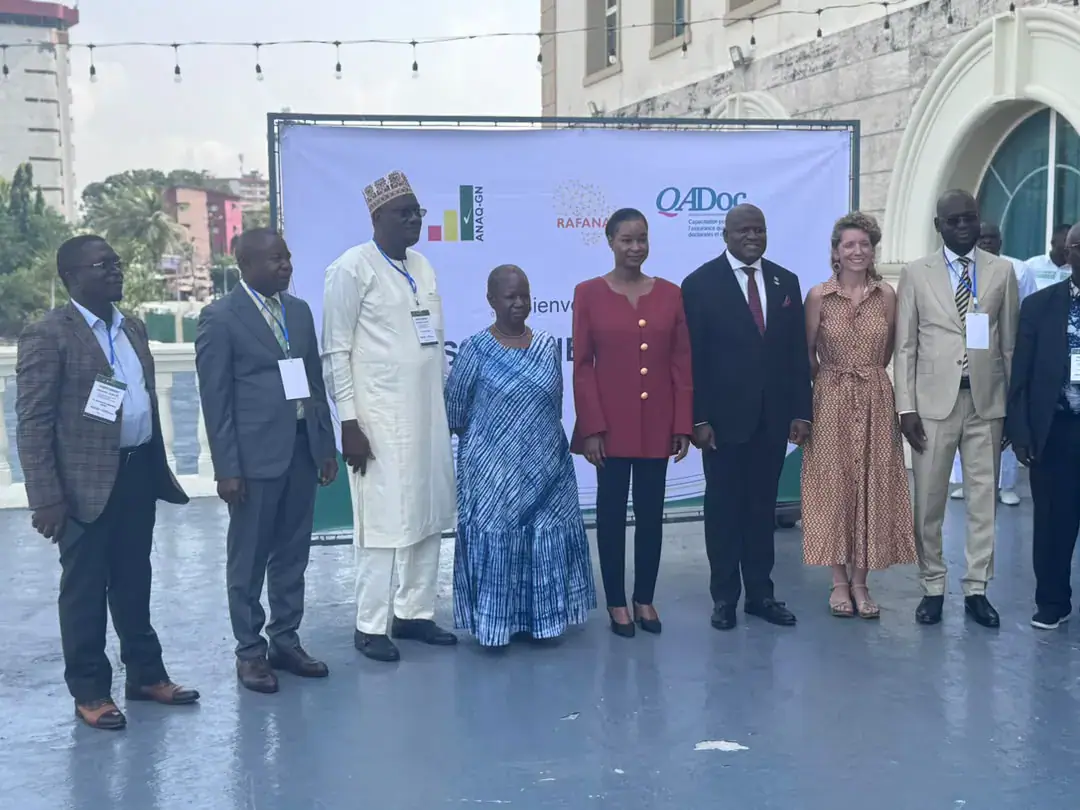
The QADoc project, implemented over three years, aimed to improve the quality of higher education and scientific research in Africa by strengthening evaluation mechanisms for doctoral schools and research institutions. The project, funded by the European Union under the Erasmus+ program, brought together six universities, three national quality assurance agencies, and three ministries from Guinea, Senegal, and the Democratic Republic of Congo.
The project has enabled the development of adapted evaluation tools for doctoral training and research structures in Guinea, Senegal, and the Democratic Republic of Congo. According to Professor Kabinet Oularé, Secretary Executive of the National Authority for Quality Assurance in Guinea (ANAQ-Guinea), the project involved a diagnostic study of the situation in partner countries, production of a report, and development of an evaluation framework and tools.
The QADoc project fostered collaboration between Guinea, Senegal, and the Democratic Republic of Congo, with the support of the European Union and European universities. The participatory approach allowed for the design and testing of common evaluation tools. Two Guinean universities, Gamal and Sonfonia, benefited from this evaluation, which also used the tools developed to assess other research institutions.
The impact of QADoc is already visible, particularly in the knowledge and documentation of the state of national research structures. Professor Oularé noted that the project enabled the evaluation of research structures, which was not previously evident, especially since research institutions have recently been restructured.
Elisabeth Coluche, Director of Education Programs and Policy at the European Union, stated that the QADoc initiative illustrates the evolution of the Erasmus+ program, which now focuses on broader university partnerships. The program allows European and African higher education institutions to build projects, share experiences, and develop new pedagogical and institutional approaches.
Professor Thia Mansour, Coordinator of the UCAC, presented QADoc as a response to the need for tools adapted to African realities in evaluating doctoral training and research. The project brought together experts from Senegal, Guinea, and the Democratic Republic of Congo to develop guides and references that constitute evaluation tools for doctoral training and research.
The Minister of Higher Education and Scientific Research, Djami Diallo, emphasized that the quality of doctoral training and research is a major challenge for the credibility of African universities and their contribution to development. She highlighted the partners' willingness to build evaluation mechanisms adapted to the continent's realities while meeting international standards.
Key points
- The QADoc project developed common evaluation tools for doctoral training and research in Guinea, Senegal, and the Democratic Republic of Congo.
- The project was funded by the European Union under the Erasmus+ program and brought together six universities, three national quality assurance agencies, and three ministries.
- The initiative aims to improve the quality of higher education and scientific research in Africa by strengthening evaluation mechanisms for doctoral schools and research institutions.