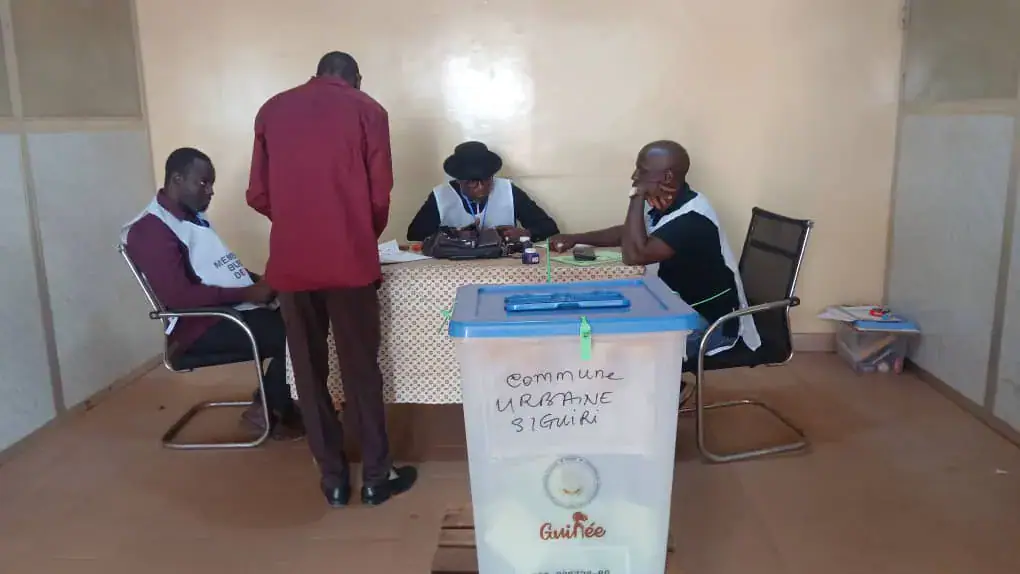
In Guinea's Siguiri prefecture, an indirect election was held on November 29, 2026, to elect regional councilors. The election involved municipal councilors recently installed, who were tasked with choosing their representatives for the future regional council. According to Lamine Bereté, director of the Siguiri Prefectural Elections, and Lanfia Ibn Mohamed Condé, treasurer of ONASUR-E and coordinator of the supervision of Siguiri and Kankan regions, the electoral process was carried out smoothly.
Lanfia Ibn Mohamed Condé reported that the election process was generally satisfactory, with operations proceeding under good conditions. He emphasized that this consultation was particular, as it involved indirect suffrage, unlike general elections where citizens directly vote for their representatives. In this election, municipal councilors were responsible for electing representatives to sit on regional bodies. This specificity distinguishes the current election from previous consultations.
Lamine Bereté discussed the preparations undertaken by the Prefectural Directorate of Elections to ensure the smooth conduct of the vote. He stated that stakeholders had received training and that teams responsible for organization had been established before the start of operations. Bereté confirmed that the election had effectively begun in the concerned localities of the prefecture, with the participation of four sub-prefectures.
The Siguiri prefecture has seven communes involved in this election, with a total of nine regional councilors to be elected. The urban commune of Siguiri and that of Norassoba each have two seats, while the other five communes have one seat each. This distribution of seats highlights the importance of the election in shaping regional representation.
Beyond the designation of future regional representatives, this election constitutes a significant step in establishing local governance bodies. It also underscores the role now assigned to municipal councilors in structuring the representation of territorial communities at the regional level. According to sources, the election process was transparent and well-organized.
The election took place in a context marked by the recent installation of new communal councils, which are now called upon to play a determining role in setting up regional institutions. The involvement of municipal councilors in the election of regional representatives demonstrates the evolution of Guinea's decentralization process.
The successful conduct of this indirect election paves the way for the effective establishment of regional councils in Guinea. The elected councilors will play a crucial role in regional decision-making and governance. Key stakeholders have expressed satisfaction with the election process, highlighting its importance in consolidating local democracy.
Key points
- Nine regional council seats were up for grabs in the indirect election in Guinea's Siguiri region.
- The election involved municipal councilors choosing their representatives for the future regional council.
- The successful election paves the way for the establishment of regional councils in Guinea.