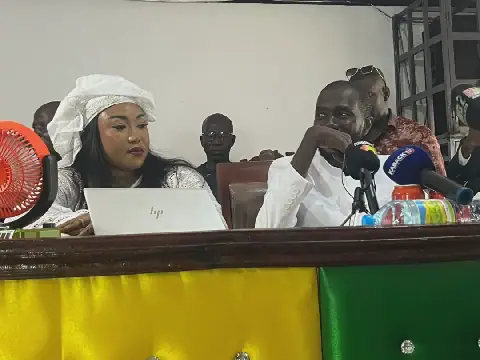
The Ministry of Modernization of Administration and Public Service in Guinea organized a workshop on October 28, 2026, to present new texts, organizational frameworks, and a competency reference system. The event, held at the Chapiteaux du Palais du Peuple in Conakry, was attended by Minister Faya François Bourouno, his counterpart Minister Laye Sékou Camara, and several high-ranking officials. The workshop aimed to present the results of the data collection on texts and organizational frameworks and to expose the structure and usage modalities of the Reference System of Professions and Competencies (RMC).
The workshop featured presentations by Alhassane Bangoura, Director National of Modernization, Administrative Transformation, and Simplification of Procedures, and Karamba Guirassy, General Director of Public Service. They highlighted the results of nearly two weeks of work, focusing on five main areas, including the genesis of texts and organic frameworks, the limits of the old system, and the innovations brought to the RMC. The presentations also emphasized the importance of a new artificial intelligence system, "Founba," designed to support the modernization of Guinea's administration.
According to the presenters, the reform has led to significant discoveries, including the existence of 64,000 fictitious matricules in the public service. The reform has also enabled the identification of actual public service agents through biometric facial recognition, Iris, and fingerprinting. As a result, the government has made considerable savings, with 643 billion in economies realized between 2024 and 2026. The new system has also allowed for a more accurate count of public service agents, with 128,000 agents identified, including both civil servants and contract workers.
The workshop also highlighted the need for a recruitment policy that balances quantitative needs with qualitative requirements. The policy should be based on a prospective approach and an economic dimension, taking into account the country's needs and the competencies required. The presenters emphasized that recruitment should not be driven solely by pressure from unions but rather by a well-planned strategy.
The validation of texts and organic frameworks for central administration structures was also discussed. Out of 905 structures created by decree, 646 have been validated, including 395 support services, 61 cabinet organs, and 286 directions and attached services. However, 220 texts remain to be validated, particularly in ministries that have not yet submitted their texts and frameworks for examination.
Minister Faya François Bourouno praised the work accomplished during the workshop and highlighted the distribution of personnel within ministerial departments. He noted that no department has fewer than 60 agents and emphasized the importance of clarifying the missions and roles of agents within each ministry.
The modernization efforts aim to improve the efficiency and transparency of Guinea's public administration. The new competency reference system and organizational frameworks are expected to enhance the performance of public services and promote a more effective use of resources. The government plans to continue the validation process for remaining texts and frameworks and to implement the new policies and systems nationwide.
Key points
- The Guinean government has made significant progress in modernizing its public administration, including the creation of a new competency reference system and the validation of texts and organic frameworks for central administration structures.