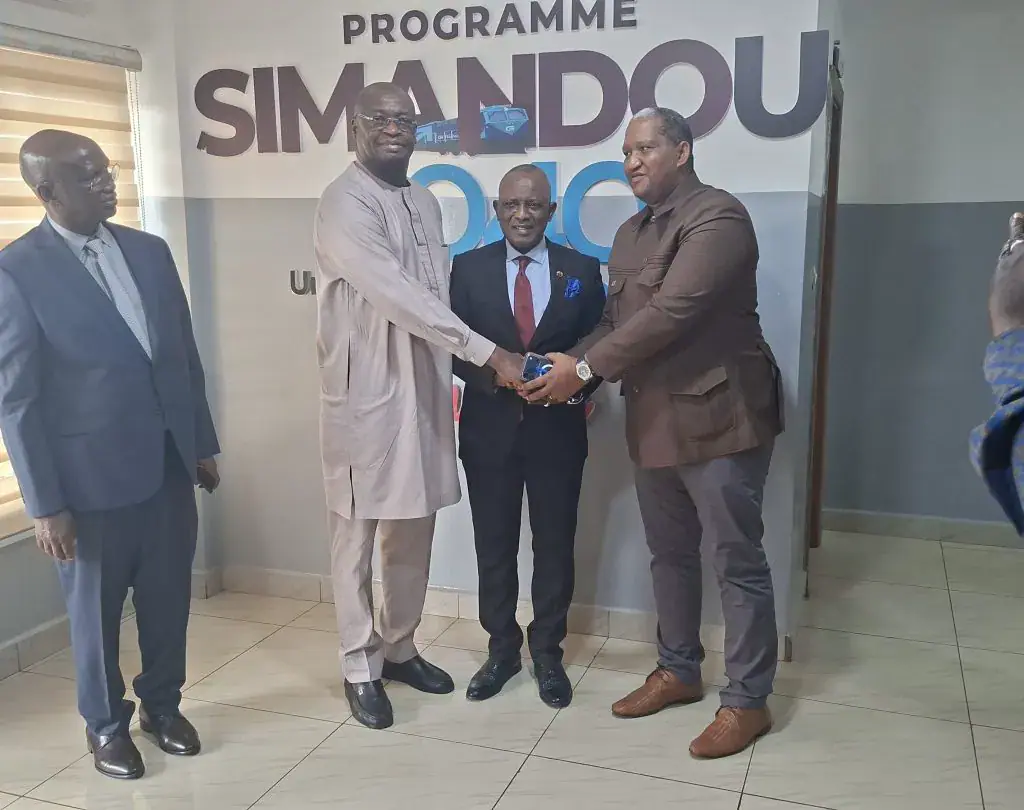
The Federation of Private Press Associations of Guinea (FEPAPGUI) and the General Confederation of Guinean Enterprises (CGE-GUI) met with Guinea's Minister of Communication, Digital Economy, and Innovation on November 18, 2026. The meeting aimed to discuss the challenges faced by private press companies, including taxation, public subsidies, social protection, collective agreements, and access to institutional markets. FEPAPGUI's new executive bureau, led by Amadou Tham Camara, presented the concerns of the private press sector.
Amadou Tham Camara emphasized that the press is not only a social institution but also a significant economic sector, generating investments, creating jobs, and contributing to the country's wealth. Despite efforts to transform and professionalize the media, private press companies face economic difficulties, including competition from large digital platforms, a fragile advertising model, equipment costs, and social protection constraints. The FEPAPGUI president presented seven key concerns to the minister, including tax adjustments, acceleration of collective agreements, and increased public subsidies.
The FEPAPGUI submitted a proposal to increase public subsidies to 15 billion Guinean francs for 2027 and sought better remuneration for journalistic content used by digital platforms. They also requested improved access to public and institutional markets, capacity building, and digital transformation. Additionally, the federation asked for increased allocations to the audiovisual sector. Amadou Tham Camara stressed the need to balance social ambitions with the financial capacity of companies to honor their commitments.
Kaba Diakité, Vice-President of CGE-GUI, expressed his organization's commitment to supporting FEPAPGUI in its actions. He recalled that CGE-GUI had supported the creation of FEPAPGUI, both technically and financially, and aims to make it an autonomous and credible structure. The patronage intends to continue its engagement in favor of the collective agreement of the press, as taken during the tripartite negotiations of November 2023.
In response, Minister Fana Soumah praised the consultation approach and emphasized the need to consider the private press as a genuine economic sector. He encouraged FEPAPGUI to make its mandate an opportunity for gathering and restructuring the press patronage. The minister expressed his willingness to establish a regular dialogue framework with concerned organizations and promised a gradual approach to resolving the difficulties faced by the private press.
The meeting marked a new sequence of dialogue between the public authorities, patronage, and press companies. For FEPAPGUI, the challenge is now to transform expressed concerns into concrete commitments, with the renewed support of CGE-GUI. The minister's progressive approach aims to find solutions to the economic challenges faced by the private press sector.
The discussions highlighted the importance of a free, professional, responsible, and economically viable press in achieving national ambitions, particularly those outlined in the Simandou 2040 program. The FEPAPGUI and CGE-GUI will continue to work together to consolidate and develop the Guinean media sector.
Key points
- The Guinean government has promised to consider the private press as a key economic sector and to establish a regular dialogue framework with press organizations.
- The FEPAPGUI has requested increased public subsidies and better remuneration for journalistic content used by digital platforms.
- The CGE-GUI has reaffirmed its commitment to supporting FEPAPGUI in its actions and to promoting the collective agreement of the press.