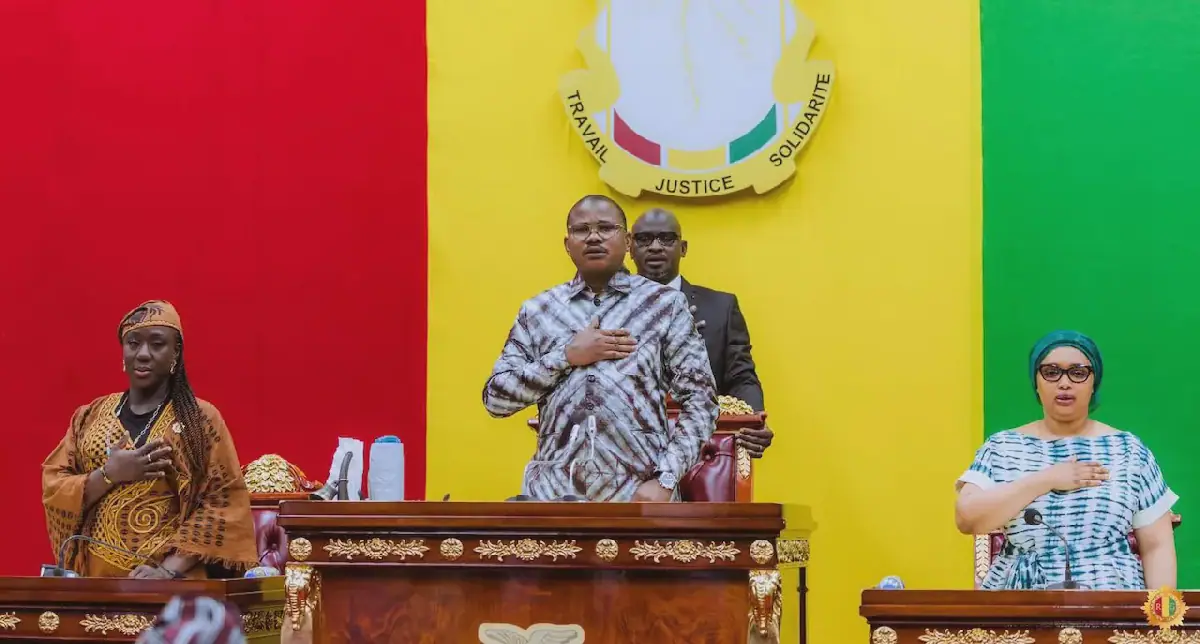
On October 31, 2026, Guinea's National Assembly adopted the revenue section of the 2026 revised finance bill (LFR) in a plenary session. Following the vote, Assembly President Dr. Dansa Kourouma addressed nine key demands to the government. These demands focus on public revenue mobilization, financial governance, management of mining resources, and oversight of external financing. Kourouma emphasized the importance of upholding the hierarchy of norms and legal provisions governing public finance management.
Dansa Kourouma expressed concern over the government's failure to transmit the required table of credit movements, as stipulated in Article 51 of the Organic Law on Finance Laws (LORF). He also criticized instructions issued by the Regulatory Authority for the Gaming Sector and Similar Practices (ARSJPA), which allegedly led to certain operators evading legally instituted taxes. The Assembly President stressed that no state organ can disregard the law and that the hierarchy of norms is non-negotiable.
Kourouma highlighted issues with revenue governance and budget sincerity, noting that only 30% of administrative revenues are based on legal foundations, while the remainder are collected under outdated or non-existent texts. He urged the government to rapidly review and rectify these issues to ensure the legality of public finance management. According to prior parliamentary work, 30% of these revenues are based on legal foundations, 45% on outdated or incomplete texts, and 25% have no legal basis.
The Assembly President addressed the issue of revenue mobilization, citing that out of 1,200 billion Guinean francs in confirmed tax claims from 45 large enterprises, only 17% have been recovered. The Guinean Radio and Television Authority (ARPT) still owes 108 billion francs for 2025. Additionally, no confiscated assets have been collected, 18 of 34 public companies paid no dividends in 2025, and 2,594 billion francs owed by SOGES and SOGEKA remain deferred due to unpaid EDG debts.
Dansa Kourouma also emphasized the need for the government to effectively utilize its legal instruments to collect outstanding debts. He noted that the discrepancy between the reference price of bauxite and declared turnover reached 13,805 billion francs in 2023. The Assembly has used its powers under Article 57 of the LORF to increase revenue and financing resource projections by 2,764.3 billion francs. This adjustment will enable a reduction in Treasury bond issuance and clearance of 1,228.4 billion francs in arrears.
The Assembly President stressed the importance of mastering the country's mineral resources, particularly in light of the Simandou project. He called for the acquisition of weighbridges and the establishment of a national reference laboratory to accurately assess the quantity and quality of exported minerals. Kourouma also demanded clarification on the status of revenue-generating organizations, citing ambiguities in the legal status of ARSJPA and ARPT.
Finally, Dansa Kourouma addressed issues related to artisanal gold, which accounts for approximately 70% of Guinea's gold exports. He noted that the current tax of $50 per kilogram is equivalent to 0.06%, significantly lower than the 1% stipulated in the Mining Code. The Assembly demands that the government take measures to rectify this situation and increase revenue collection. The government is expected to respond to these demands and provide a plan for implementation.
Key points
- Guinea's National Assembly adopts 2026 revised budget with nine key demands to the government.
- Demands focus on public revenue mobilization, financial governance, and management of mining resources.
- Assembly President Dansa Kourouma emphasizes need for effective utilization of legal instruments to collect outstanding debts.