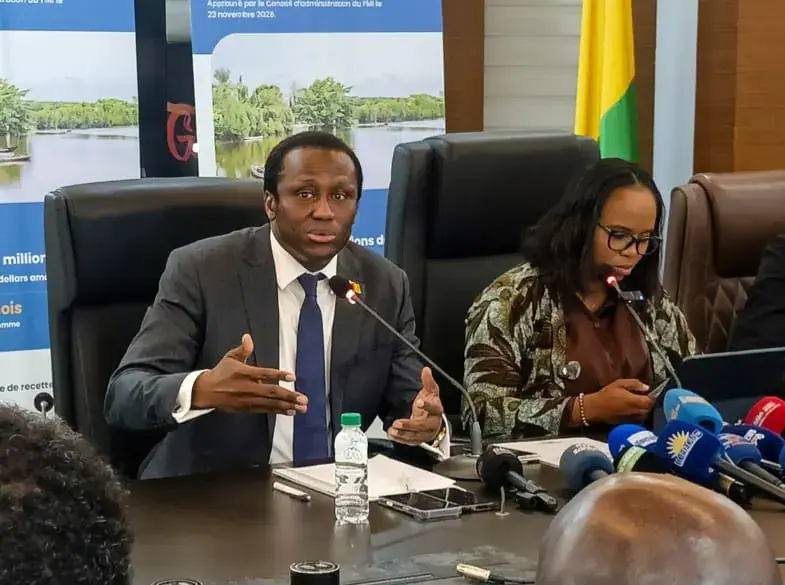
Dr. Karamo Kaba, Governor of the Central Bank of the Republic of Guinea (BCRG), has clarified the implications of the new economic and financial program between Guinea and the International Monetary Fund (IMF). In a press conference in Conakry on November 27, 2026, Kaba emphasized the country's monetary sovereignty and the autonomy of the Central Bank in defining its orientations. This statement comes after the IMF's approval of the program, which covers the period 2026-2029.
The IMF has approved a financing package of 310.59 million special drawing rights (SDRs), equivalent to approximately $425 million, to support the implementation of the program over three years. The financing will be mobilized through two mechanisms: the Extended Credit Facility (ECF) and the Extended Fund Facility (EFF). Kaba expressed satisfaction with the validation of the agreement and praised the work done by Guinean technical teams, particularly those from the Ministry of Economy and Finance and the BCRG.
Kaba sought to dispel concerns about potential IMF interference in Guinea's monetary decisions, emphasizing that the conclusion of a program with the IMF does not imply a transfer of responsibility for national monetary policy. He stated that Guinean teams, under the responsibility of the Central Bank, will continue to develop and implement monetary policy decisions. "Today, now that the program is ready, we must tell our fellow citizens the truth. The IMF will not dictate Guinea's monetary policy to us," Kaba said.
The Governor reiterated the principle of independence of the BCRG in exercising its missions, despite the financial partnership with the IMF. He described the IMF's role as providing technical and financial support, while ensuring follow-up on commitments agreed with Guinean authorities. Kaba emphasized that this support does not undermine the prerogatives of national institutions in managing the country's economic and monetary policy.
Kaba highlighted the collaborative nature of the relationship between Guinea and the IMF, with the IMF acting as a partner to provide support and monitoring. He stressed that the country's authorities will continue to be responsible for economic and monetary policy decisions during the 2026-2029 period. The Governor's statement aims to establish a clear distinction between IMF support and national responsibility for policy decisions.
The new program and financing package are expected to support Guinea's economic development and financial stability. Kaba thanked the IMF for approving the program and acknowledged the efforts of Guinean teams in concluding the agreement. The Central Bank Governor's statement reflects the country's commitment to maintaining its monetary sovereignty while engaging with international financial institutions.
The agreement with the IMF is a significant development for Guinea, demonstrating the country's commitment to economic reform and financial stability. The program is expected to support Guinea's economic growth and development, while ensuring the country's monetary sovereignty. Key aspects of the program include a focus on economic diversification, improved governance, and enhanced social protection.
Key points
- The IMF has approved a $425 million financing package to support Guinea's economic program over three years.
- Guinea's Central Bank Governor, Dr. Karamo Kaba, has reaffirmed the country's sovereignty in monetary policy.
- The program aims to support Guinea's economic development and financial stability, while maintaining the country's monetary sovereignty.