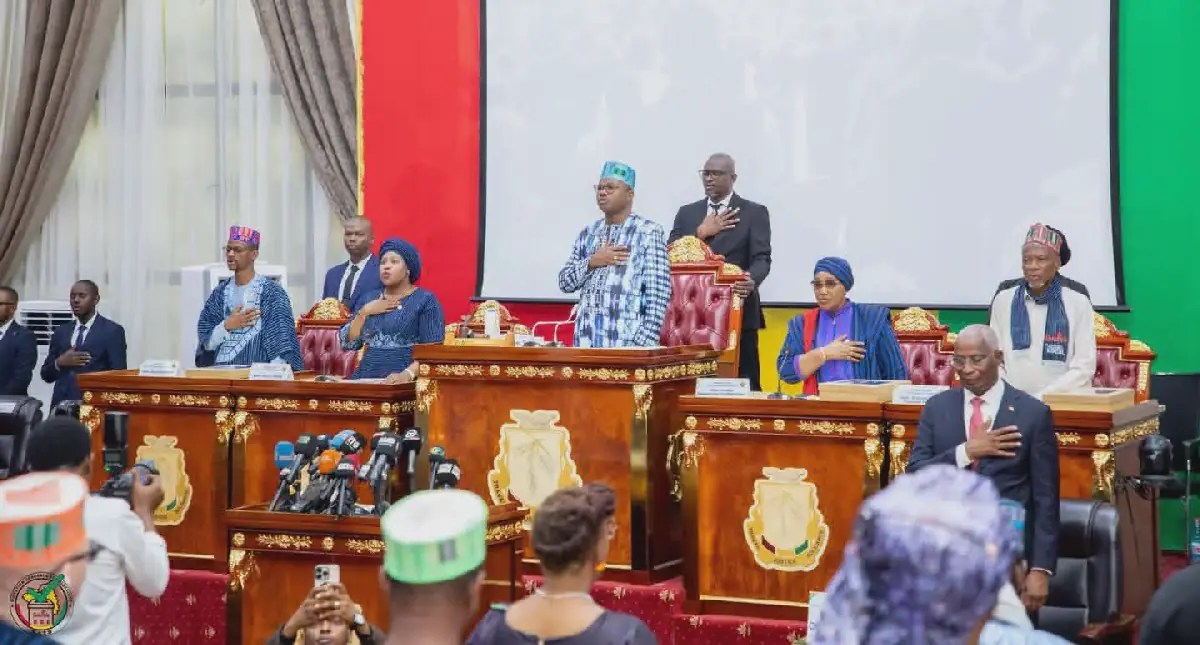
The Guinean government has acknowledged that the 2027 budget has not been transmitted to the National Assembly yet, with the constitutional deadline of October 15 already passed. However, the government is working to finalize the budget and transmit it to the Assembly before November 30. The delay is attributed to the need for a more rigorous preparation process, which involves a transition to a program-based budget. This change aims to improve the country's budgeting and execution process.
The 2026 budget was executed over nine months instead of 12 due to exceptional circumstances related to the electoral calendar. A rectified finance law for 2026 was adopted by the National Assembly on October 31 for revenue and November 7 for expenditure. The law sets revenue at 60,064 billion GNF and expenditure at 67,925.87 billion GNF, reducing the deficit to 2.01% of GDP. The government could not build the 2027 budget on changing figures, so it waited for the 2026 base to be consolidated by the National Assembly.
The 2027 budget preparation involves a historic reform, shifting from a budget of means to a program-based budget. All ministries will adopt this new approach, focusing on public policies with objectives and result indicators. The Prime Minister chaired the Exchange Days on the program-based budget reform on September 24, 2026. From November 16 to 20, 37 ministries and institutions presented their draft projects during budget conferences.
The program-based budget reform requires each ministry to redefine its programs, actions, and indicators. This process takes time but will enable the government to measure the results of every franc spent. According to the Secretary General of the Ministry of Economy, Finance, and Budget, "What we finance, we must be able to measure the results." The government is committed to ensuring that the National Assembly has sufficient time to examine the budget.
The delay in transmitting the 2027 budget to the National Assembly does not pose a risk to the continuity of the state, including payment of salaries, public services, and state commitments. The organic framework of public finances provides mechanisms to guarantee budget continuity. The government is working on final adjustments before examining the text in the Interministerial Council and then the Council of Ministers.
The government aims to have the 2027 budget promulgated by December 31, 2026, subject to parliamentary procedure. This will enable the country to start 2027 with an operational budget, a new public management architecture, and clear financing priorities. The delay is measured in weeks, but the benefits of a result-oriented budget will be measured in years.
The 2027 budget is aligned with the Simandou 2040 vision and incorporates recommendations from the Parliament. The government prioritizes having a sincere budget over a hasty one, built on a consolidated 2026 base and structured in measurable programs. The budget preparation involves a transition to a program-based budget, which will improve the country's budgeting and execution process.
Key points
- The Guinean government is transitioning to a program-based budget, focusing on public policies with objectives and result indicators.
- The 2027 budget preparation involves a historic reform, shifting from a budget of means to a program-based budget.
- The delay in transmitting the 2027 budget to the National Assembly does not pose a risk to the continuity of the state.