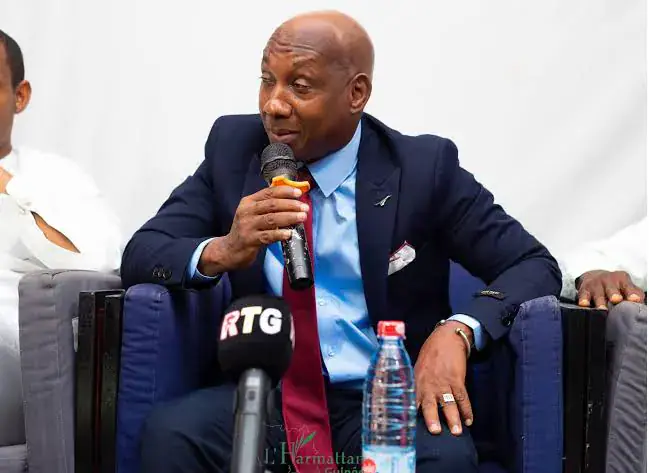
On October 29, 2026, Guinea's Minister of Economy, Finance, and Budget presented the 2026 revised budget to the National Assembly. The minister emphasized that the budget marks a turning point for Guinea, balancing macroeconomic prudence with social ambitions under the Simandou 2040 program. To understand the context, it is essential to look back at the evolution of Guinea's public finances under the current transition government, which took power on September 5, 2021.
The advent of the National Committee for Rallying and Development (CNRD) and the current government marked a significant break with the past. The new administration has prioritized refounding the state and moralizing public life. The government has acknowledged the failure of the previous governance, characterized by endemic corruption, deteriorating infrastructure, and a disconnection between the ruling elite and the population's vital needs. This situation led to a crisis of trust in fiscal and budgetary management.
The government has identified three main priorities for public finances: assuring public finances, accelerating public investments, and mobilizing more revenue. To achieve these goals, the government has taken several measures, including digitalization, securing revenue, and combating fraud. The minister reported that as of October 15, 2026, the mobilized revenue reached 44,225 billion Guinean francs, representing 85% of the initial budget forecasts. At the same time, expenditure commitments stood at 29,982 billion Guinean francs.
The government has justified its intervention by highlighting the need to address the legacy of poor governance. The new administration has launched a series of audits and investigations into past public fund management. The objective is to restore a culture of accountability and transparency. The government aims to integrate transparency as a systemic requirement, ensuring that citizens and development partners have access to information on public fund usage.
To support its policy, the government has allocated 5,489 billion Guinean francs to subsidize petroleum products, representing about 10% of the projected revenue in the revised budget. Additionally, the government has taken into account losses of revenue linked to measures on petroleum products, estimated at around 4,576.7 billion Guinean francs. These measures aim to balance economic prudence with social ambitions.
The government's economic and fiscal governance orientations are built around three main pillars: assuring public finances, accelerating public investments, and mobilizing more revenue. The administration has made a significant commitment to financing large-scale projects in infrastructure, energy, and urban planning. This approach is riskier, as it puts immediate pressure on the budget, but it responds to popular expectations for concrete achievements.
The revised budget for 2026 reflects the government's efforts to strike a balance between economic prudence and social ambitions. The minister emphasized that the budget is a turning point for Guinea, marking a shift towards more transparent and accountable management of public finances. The government's priorities are focused on improving the living standards of the population and promoting sustainable economic growth.
Key points
- The 2026 revised budget aims to balance macroeconomic prudence with social ambitions under the Simandou 2040 program.
- The government has allocated 5,489 billion Guinean francs to subsidize petroleum products.
- The administration has prioritized transparency and accountability in public fund management.