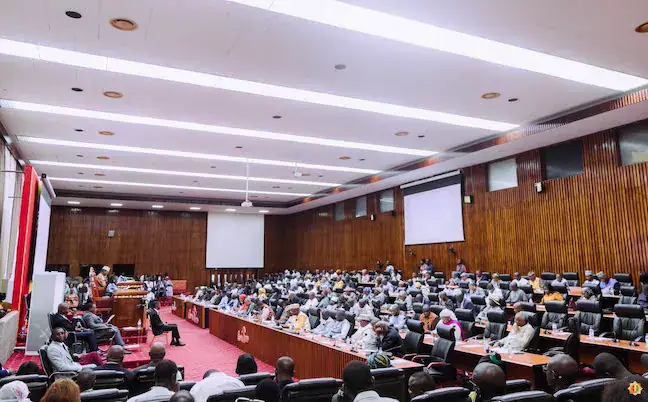
The Guinean National Assembly has adopted the revised 2026 budget, increasing total public spending to 67.925 trillion GNF, a 5.83% rise from the initial 64.181 trillion GNF. This adjustment aims to address the country's macroeconomic challenges while maintaining a stable power balance. The revised budget allocates more funds to subsidies and transfers, which have increased by 66.84% to 15.828 trillion GNF.
The bulk of the increased spending is attributed to subsidies, primarily due to the government's decision to maintain fuel prices at 12,000 GNF per liter, resulting in a loss of 4.576 trillion GNF in revenue. Additionally, a 913 billion GNF provision has been allocated for the hydrocarbon stabilization mechanism, and 564.94 billion GNF has been set aside for transfers to agricultural and commercial chambers.
The revised budget also includes increased spending on goods and services, which has risen by 876.26 billion GNF to 9.659 trillion GNF. This increase is largely due to costs associated with organizing legislative and communal elections, which account for 367.15 billion GNF. Furthermore, personnel expenses have increased by 1.02% to 12.629 trillion GNF, partly due to the recruitment of 939 new police officers and 250 billion GNF in performance bonuses for the General Directorate of Taxes.
In contrast to the increased spending on current expenditures, investment spending has decreased by 10.13% to 23.562 trillion GNF. The government justifies this decline by citing the postponement of certain projects until 2027 due to insufficient maturity levels. The investment spending is divided into project expenditures, which account for 84.95% of the total, and non-project expenditures, which make up the remaining 15.05%.
Non-project expenditures include allocations for the Road Maintenance Fund (FER) at 1.451 trillion GNF, equipment purchases for schools and healthcare facilities, and logistical support for elected officials and institutions. The government has also set aside 40 billion GNF for the purchase of urban buses.
The revised budget has resulted in a deficit of -7.861 trillion GNF. However, the deficit as a percentage of GDP has improved slightly to -2.01%, compared to -2.07% initially projected in the 2026 budget. The government aims to maintain control over the deficit while addressing pressing economic challenges.
The adoption of the revised budget reflects the government's efforts to strike a balance between economic stability and social needs. The increased spending on subsidies and personnel is expected to have a positive impact on the population, while the decrease in investment spending may have long-term implications for the country's development.
Key points
- The revised 2026 budget prioritizes subsidies and transfers, with a 66.84% increase to 15.828 trillion GNF.
- Investment spending has decreased by 10.13% to 23.562 trillion GNF due to project postponements.
- The budget deficit has improved slightly to -2.01% of GDP.