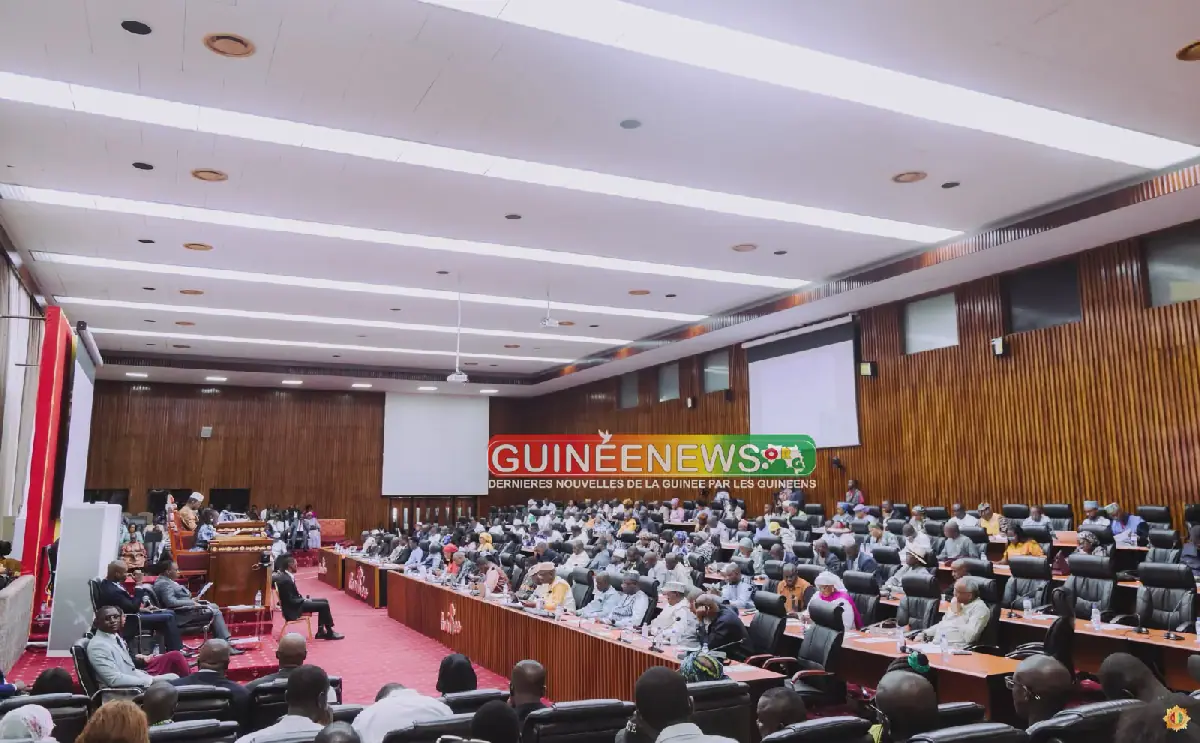
The Guinean National Assembly adopted the revised 2026 Finance Bill on November 7, 2026, with a total expenditure of 67,925.87 billion GNF. This represents a 5.83% increase from the initial budget of 64,181.37 billion GNF. The revised budget was presented by N'Gouamou Fabara Koné, rapporteur general of the Economic and Financial Affairs Committee. The new budget aims to address various sectors, including education, healthcare, and infrastructure.
The increase in expenditure is primarily driven by current spending, which rose by 18.06% to 41,954.40 billion GNF. This includes a significant increase in transfer expenditures, which grew by 66.84%. The government also allocated 4,576.7 billion GNF to compensate for losses in oil revenue and maintain fuel prices at 12,000 GNF per liter. An additional 913 billion GNF was set aside for hydrocarbon stabilization.
Personnel expenses are estimated at 12,629.84 billion GNF, representing a 1.02% increase. This includes 250 billion GNF in performance bonuses for the General Directorate of Taxes and the integration of 939 new police agents starting in August 2026. Goods and services expenditure stands at 9,659.67 billion GNF, up 9.98% from the initial budget. This includes 367.15 billion GNF for election-related expenses.
In contrast, investment spending in the general budget decreased by 10.13% to 23,562.27 billion GNF. This reduction is mainly due to the postponement of some projects until 2027. The investment spending is divided into projects worth 20,015.98 billion GNF and non-project investments of 3,546.28 billion GNF. The latter includes the Road Maintenance Fund and public equipment.
The Special Allocation Budgets (BAS) recorded a slight decrease of 0.70% to 2,409.20 billion GNF. The breakdown includes the National Local Development Fund (FNDL) with 1,114.44 billion GNF, FODECCON with 708.26 billion GNF, the Mining Investment Fund (FIM) with 371.48 billion GNF, and the Education Common Fund (FCE) with 215.02 billion GNF.
The revised budget also aligns with the Simandou 2040 program, which aims to drive economic growth and development. A total of 176 projects from this program are included in the revised budget, with an allocation of 10,137.65 billion GNF. This represents 43.61% of the state's total investment spending. The budget also includes targeted amendments to address sectoral priorities.
The revised budget has a global deficit of 7,861.40 billion GNF, equivalent to 2.01% of GDP. The deficit is expected to be fully covered by domestic and foreign financing operations. The government's efforts to adjust the budget and prioritize sectoral spending aim to promote economic growth and improve living standards in Guinea.
Key points
- The revised 2026 budget for Guinea is 67,925.87 billion GNF, a 5.83% increase from the initial budget.