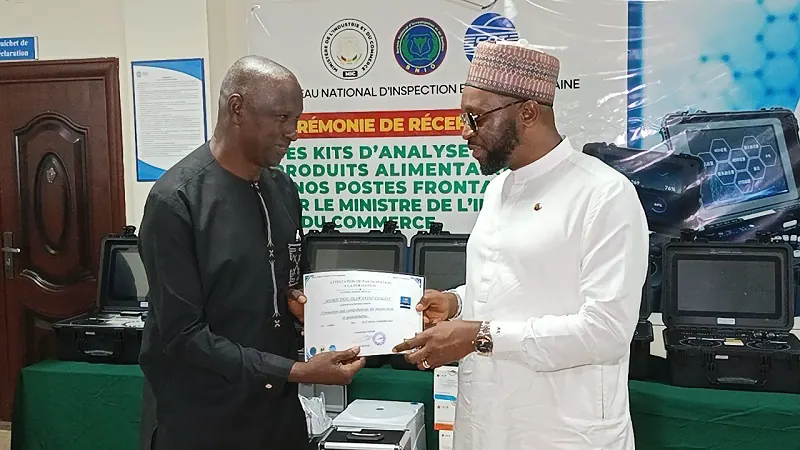
The Guinean government has taken a significant step in strengthening its sanitary control of goods entering and leaving the country. On October 9, 2026, Industry and Commerce Minister Aboubacar Kourouma presided over the reception of the first rapid food analysis kits at Kaloum. This initiative, led by the SCALE project and the National Bureau of Quarantine Inspection (BNIQ), aims to protect consumer health, enhance market confidence, and facilitate trade.
The ceremony was attended by several Ministry of Industry and Commerce officials, BNIQ members, and SCALE project representatives. After the equipment presentation, participants watched a video showcasing the technological inspection and quarantine center, followed by official interventions. These new kits will enable competent authorities to quickly detect potential non-compliances in imported or exported food products. They complement the existing border inspection system, supported by a laboratory for in-depth analysis and trained agents.
Boubacar Cissé, BNIQ inspector, highlighted the significance of these tools for surveillance and public health protection. He explained the procedure, from product declaration to physical inspection and sample analysis. According to Cissé, the kits allow for precise information on goods entering or leaving Guinea. A laboratory accompanies these rapid detection devices, and several agents have been trained in their use.
The procedure begins with product declaration on the BNIQ platform. A technical team examines the documents and evaluates the merchandise risk level. Inspection agents verify document conformity with the products, and if necessary, samples are taken for rapid analysis, which takes a maximum of 50 minutes. This project aims to better guarantee public health and promote international trade by strengthening border control.
The SCALE project also aims to enhance the operational capacities of inspection services, particularly in remote border areas. The kits will be deployed at land and maritime borders, enabling rapid on-site analysis. BNIQ and SCALE project coordinator Ousmane Madani Diallo emphasized the importance of these kits in improving merchandise safety and control.
Seven kits are available, with four to be deployed in high-traffic border areas and one at the conventional port. The devices will allow for rapid food product analysis. Diallo stressed that the project will strengthen product safety and control, particularly in remote areas. The goal is to make BNIQ a coordination instrument for sectoral interventions to ensure better commercialized product quality.
Minister Aboubacar Kourouma praised the efforts made to implement the SCALE project, highlighting its strategic importance in controlling imports and protecting consumers. The reception of these kits represents a symbolic step towards strengthening import control and consumer protection. The project aligns with the Guinean government's vision to restore market confidence and accelerate trade.
Key points
- The Guinean government receives rapid food analysis kits to enhance border control and protect consumer health.
- The kits will be deployed at land and maritime borders to enable rapid on-site analysis.
- The project aims to strengthen product safety and control, particularly in remote areas.