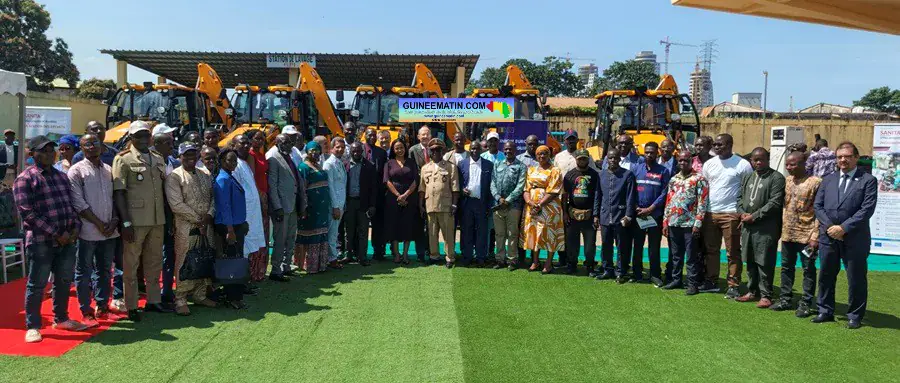
In a ceremony held on November 4, 2026, in Conakry's Kaloum commune, Guinea's National Agency for Sanitation and Public Health (ANASP) received 7 tractopelles and 42 waste bins to enhance urban sanitation. The equipment, valued at €858,000, was financed by the European Union through the Belgian Development Agency (Enabel). The initiative aims to improve waste collection, transfer, and management, ultimately enhancing the living conditions of local populations.
The project, part of the SANITA program funded by the European Union, targets communes in Grand Conakry, Kindia, and Labé. Despite previous investments in infrastructure and capacity building, local communes still face significant operational challenges, including inadequate equipment and inefficient waste transfer processes. The newly provided tractopelles and waste bins are expected to alleviate these issues. The tractopelles are valued at €539,000, while the waste bins, with a capacity of 20 cubic meters each, are worth €319,000.
The ceremony was attended by several high-profile guests, including the European Union's ambassador to Guinea, the Belgian ambassador, and representatives from various government ministries. The event marked a significant milestone in the partnership between Guinea, the European Union, and Belgium. According to Saïd Kermaoui, Enabel's resident representative in Guinea, the equipment will help strengthen the effectiveness of the waste management chain, but emphasized the need for coordination among all stakeholders.
Olivier Chanoine, coordinator of the SANITA 3 project, highlighted that the new equipment complements previous efforts to establish a more efficient and sustainable waste management system. Since 2018-2019, the project has been supporting local communes with equipment, infrastructure, and capacity building. Chanoine stressed that despite progress, challenges persist, and the project aims to create a lasting impact beyond its duration.
Local authorities have welcomed the donation, citing the financial and operational relief it provides. Elhadj Mohamed Bangoura, mayor of Coyah, expressed satisfaction with the support, which he believes represents a significant advancement for his commune. He pledged to ensure proper use and maintenance of the equipment. The mayors of other beneficiary communes are expected to follow suit, prioritizing effective waste management and sanitation.
Fatoumata Diaraye Diallo, chief of staff to the Minister of Sanitation, Hydraulics, and Hydrocarbons, praised the initiative, emphasizing the government's commitment to prioritizing sanitation. She stressed the importance of rational use, regular maintenance, and rigorous monitoring of the equipment's allocation and use in beneficiary communes.
The ANASP agency's efforts to improve urban sanitation in Guinea are ongoing, with a focus on enhancing waste management and promoting a healthier environment. The newly received equipment is expected to play a crucial role in achieving these goals, and stakeholders are committed to ensuring its effective use.
Key points
- The European Union-funded project aims to improve waste management in Guinea's urban areas.
- The equipment will benefit communes in Grand Conakry, Kindia, and Labé.
- The project is part of a broader effort to enhance sanitation and public health in Guinea.