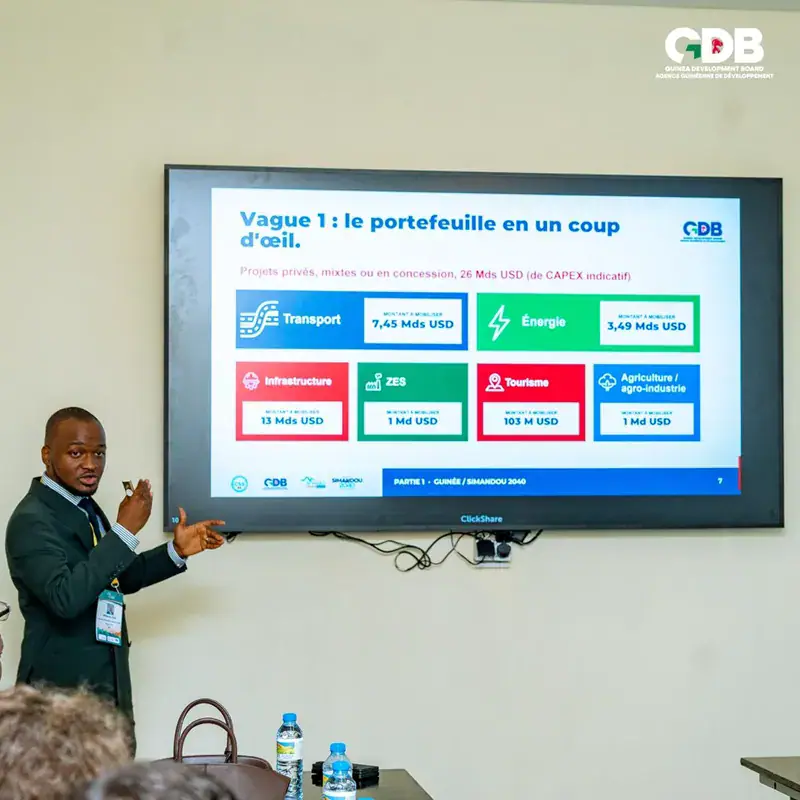
The Guinean government, through the Guinean Development Agency (GDB), has presented four priority projects at the Simandou Mining Summit 2026 to mobilize private investment and international funding in strategic sectors. These projects, part of the Deal Room, focus on urban transportation, road infrastructure, and energy, aligning with the country's broader ambitions of economic diversification, infrastructure modernization, and sustainable development.
The first project involves establishing a Bus Rapid Transit (BRT) system in Greater Conakry, with a $361 million investment. The project, led by the Ministry of Transport, aims to improve urban mobility, reduce congestion, and facilitate daily commutes. The planned 39.2-kilometer route will have 51 stations, potentially transporting 275,000 passengers daily by 2030 and up to 420,000 by 2040.
The second project concerns the Heavy Rail Transit (HRT), a 35-kilometer urban rail system connecting Kaloum to Kagbélen, with 15 stations. Estimated at $693 million, this infrastructure is expected to transport between 184,000 and 289,000 passengers daily, with a travel time of 50 to 70 minutes. The BRT and HRT systems are designed to provide a multimodal transportation solution for Greater Conakry's growing population.
The third project involves constructing the Coastal Road South, a $2.6 billion infrastructure. The 43-kilometer toll road will connect Coléah to Coyah, with intermediate accesses to Matam, Tombolia, and Kountyah. The project includes a two-lane road, a sea bridge, and drainage and toll equipment. It aims to reduce congestion, decrease travel times, and improve connections between Conakry and the future Southern Corridor.
The fourth project focuses on building two solar photovoltaic power plants with battery storage systems in Dabola and Faranah prefectures. With a total estimated cost of $148 million, the program aims to increase national electricity production capacity and diversify the energy mix with renewable sources. The projects have feasibility studies underway, with a planned timeline for financing in 2027, construction between 2027 and 2028, and commissioning in 2029.
These four projects, representing a total financing need of approximately $3.8 billion, aim to attract investor interest, financial institutions, developers, and international operators. The Simandou Mining Summit's Deal Room provides a platform for direct exchanges between project leaders and potential partners to explore financing, construction, and operation possibilities.
The initiatives demonstrate Guinea's commitment to using the Simandou 2040 program as a driver of economic transformation, prioritizing infrastructure, urban mobility, and energy access. According to organizers, around 20 other projects will be presented to potential investors on November 13 as part of the Simandou 2040 program.
Key points
- The Guinean government presents four priority projects at the Simandou Mining Summit 2026 to attract $3.8 billion in funding for urban transportation, road infrastructure, and energy.