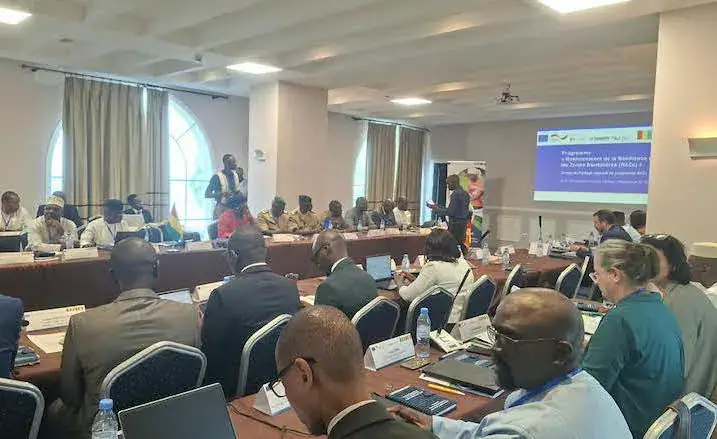
The second regional steering committee meeting of the RéZo program took place in Conakry on November 25-26, 2026. The meeting brought together representatives from the governments of Guinea, Mali, and Senegal, along with technical and financial partners, including the European Union, Germany, GIZ, Coginta, and the Centre for Humanitarian Dialogue (HD). The committee evaluated the progress made since the first session in Dakar in October 2025.
The RéZo program has achieved tangible results in its first year of implementation. As of October 2026, 585,000 people have gained better access to basic social services such as water, electricity, and education, out of a target of 2 million inhabitants. Additionally, 43 social infrastructure projects have been rehabilitated, and over 2,500 young people and women have received technical, vocational, and entrepreneurial training, enabling 10,000 people to improve their incomes.
The program has also made strides in promoting trans-border governance and stability. Over 200 local actors are actively cooperating, and the Local Grouping of Trans-border Cooperation (GLCT) Ambidédi-Bakel-Sadiola (Mali-Senegal) was officially established in September 2026. Another GLCT, Koundara-Salémata-Vélingara (Guinea-Senegal), is set to be launched in December. Furthermore, 211 gendarmes and 27 sub-prefects have been trained in Senegal by Coginta, and three community engagements for peaceful natural resource management have been signed in Mali with HD's support.
The meeting saw a reaffirmation of the commitment to transform border areas into levers of integration. Guinean Minister of Territorial Administration and Decentralization, Djenabou Touré, emphasized that border areas should be considered as development and integration hubs, rather than peripheral zones. She stressed that strengthening borders means not only securing them but also improving access to public services and offering populations real prospects.
European Union Ambassador to Guinea, Xavier Sticker, highlighted the importance of the €30 million investment and the need to connect these territories. He noted that borders are often sensitive areas, but the goal is to make them corridors of continuity, where being at a border represents an advantage, not a disadvantage. German Ambassador to Guinea, Irène Biontino, emphasized the solidarity among stakeholders and the need for sustained German support.
The Malian and Senegalese delegations recommended increasing operational efficiency and densifying material achievements. Moussa Bilane, Technical Advisor to the Malian Ministry of Territorial Administration and Decentralization, called for a collective approach, focusing on trans-border cooperation and mutualization of efforts. Senegalese General Cheikhou M. L. Boukounta Camara urged the program to prioritize investments in economic and social infrastructure to accelerate harmonious development in border territories.
The meeting concluded with the adoption of recommendations and strategic orientations for the next 12 months. The three nations and their partners aim to amplify the impact of the RéZo program in 2027, benefiting the 63 targeted border communes. The program's progress and future plans will be crucial in enhancing resilience and promoting development in these regions.
Key points
- The RéZo program has achieved significant progress in its first year, including improved access to basic social services for 585,000 people and the rehabilitation of 43 social infrastructure projects.