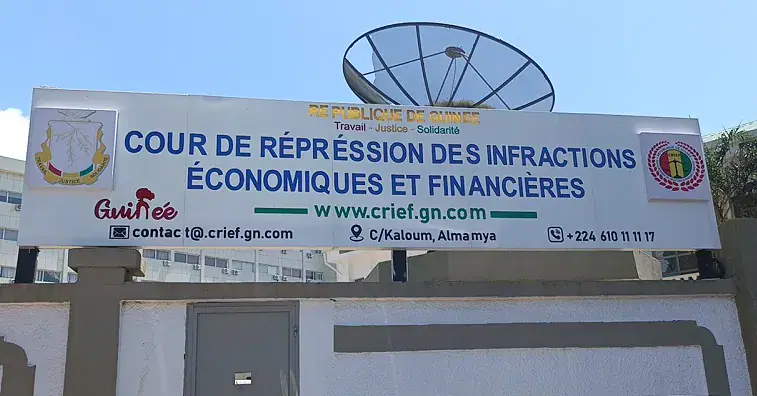
On November 4, 2026, the Guinean Court of Repression of Economic and Financial Infractions (CRIEF) delivered its verdict in a high-profile case involving a lawyer and two court officials. The defendants, lawyer Halimé Saad Chaloub, and court officials Sory Daouda Camara and Mandiou Sangaré, were found guilty of various offenses, including judgment fraud, impersonation, and complicity. The case was brought by Ecobank Guinea, which claimed the defendants had engaged in fraudulent activities.
According to the court's findings, the two court officials, Sory Daouda Camara and Mandiou Sangaré, were convicted of impersonation and complicity in impersonation. They were sentenced to two years with probation. The lawyer, Halimé Saad Chaloub, was found guilty of judgment fraud and sentenced to three years in prison. A warrant was issued for her arrest at the hearing. Each defendant was also fined 30 million Guinean francs.
The case was initiated by Ecobank Guinea, which accused the defendants of engaging in fraudulent activities, including judgment fraud, forgery, and use of forged public and authentic documents, impersonation, and complicity. The bank's lawyers had demanded that the court order the defendants to pay 5 million dollars and 20 billion Guinean francs in damages. The prosecution had requested sentences of seven years in prison and fines of 50 million Guinean francs for each defendant.
The prosecution, represented by Pierre Segbe Kamano, had also requested additional penalties, including temporary bans on practicing as court officials or lawyers for three years. The defense, however, argued that the proceedings were biased and unbalanced. The court's decision was delivered after considering the evidence presented during the trial.
The CRIEF court rejected the charge of forgery, citing that the offense was time-barred. However, the court upheld the charges of impersonation and judgment fraud. The defendants' lawyers had claimed that they were innocent of the charges. The case has garnered significant attention in Guinea, highlighting concerns about corruption and accountability in the country's justice system.
Ecobank Guinea's lawyers had argued that the convictions and damages were necessary to restore the bank's rights. The court's decision is seen as a significant step towards holding accountable those who engage in corrupt activities in Guinea. The case will likely have implications for the country's justice system and its efforts to combat corruption.
The defendants' sentences and fines reflect the seriousness with which the court viewed their offenses. The case serves as a reminder of the importance of upholding the law and ensuring accountability in Guinea's justice system. The court's decision has been reported by local media outlets, including Guineematin.com.
Key points
- A Guinean court has sentenced a lawyer and two court officials for judgment fraud, impersonation, and other offenses.
- The defendants were fined 30 million Guinean francs each and received prison sentences ranging from two years with probation to three years in prison.
- The case was brought by Ecobank Guinea, which accused the defendants of engaging in fraudulent activities.