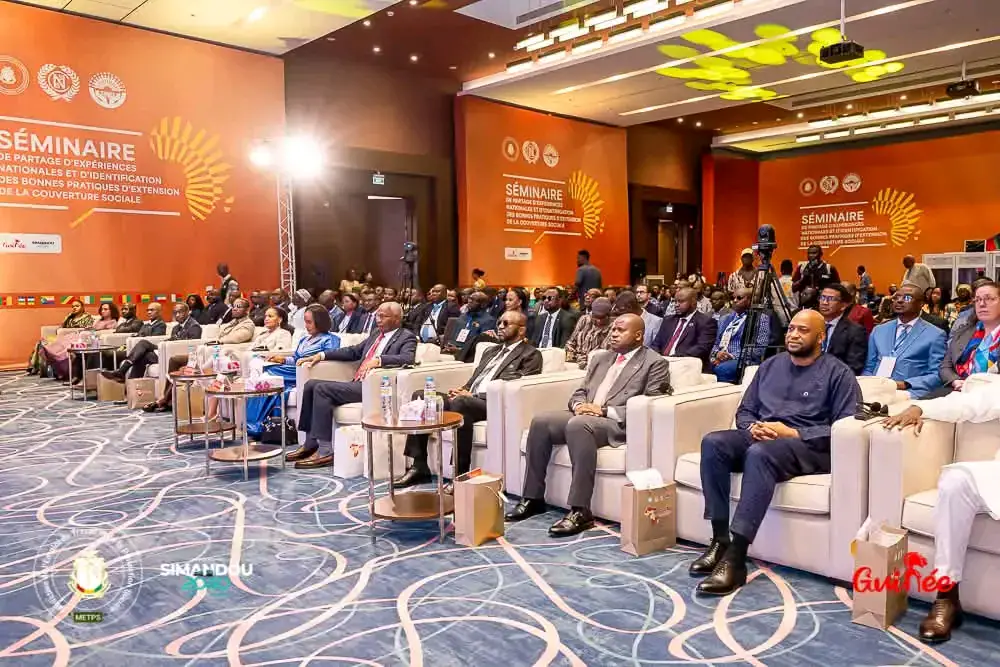
The seminar, which began on November 16, 2026, at the Radisson Blu hotel in Conakry, is being organized by the Guinean National Social Security Fund (CNSS) in collaboration with the Inter-African Conference of Social Security (CIPRES) and the Ministry of Employment, Labor, and Social Protection. The event brings together experts, policymakers, and social partners to address the challenge of integrating informal economy workers and rural populations into social safety nets.
The Guinean Prime Minister, Amadou Oury Bah, presided over the opening ceremony, which was attended by several government ministers, including Ramatoulaye Camara, Minister of Employment, Labor, and Social Protection, and Khaité Sall, Minister of Health and Public Hygiene. The objective of the seminar is to provide a platform for theoretical and practical exchanges between CIPRES member states and other countries to validate adaptable solutions to national realities.
The Director-General of the CNSS, Bakary Sylla, noted that the current social security system was designed primarily for salaried workers, leaving a large majority of the active population without coverage. He emphasized that workers in the informal sector, including artisans, farmers, and traders, contribute to the country's wealth and deserve protection against illness, old age, and life accidents.
To build a reform on a scientific basis, the CNSS launched an actuarial study with the International Labor Bureau (ILB) in 2023, coupled with field surveys by the National Institute of Statistics (INS). The study aimed to design a contribution model adaptable to each worker's economic reality while preserving the system's overall balance.
Samira Daoud, Director of the ILB office for Senegal, recalled that social protection is a fundamental human right enshrined in the UN's 2030 Agenda. She cited a report indicating that 52% of the world's population benefits from at least one social protection benefit, while nearly 3.8 billion people remain unprotected. In Africa, only one in five people has access to at least one benefit.
The Minister of Employment, Labor, and Social Protection, Ramatoulaye Camara, emphasized that the reform aims to make social protection a pillar of Guinea's refoundation. She outlined three key areas of focus, including revising the Social Security Code, extending coverage to informal workers and independents, and protecting workers on major projects, such as the Simandou program.
The seminar's outcome is expected to provide operational recommendations to benefit millions of citizens. The President of the CIPRES Surveillance Commission, Sani Mahaman Brah, noted that only 3.14% of the population in CIPRES member states are covered for at least one social risk, highlighting the need for collective intelligence to address the challenge.
Key points
- The seminar aims to provide a platform for theoretical and practical exchanges between CIPRES member states and other countries to validate adaptable solutions to national realities.
- The Guinean government has launched a reform to make social protection a pillar of the country's refoundation, with a focus on extending coverage to informal workers and independents.
- The current social security system in Guinea was designed primarily for salaried workers, leaving a large majority of the active population without coverage.