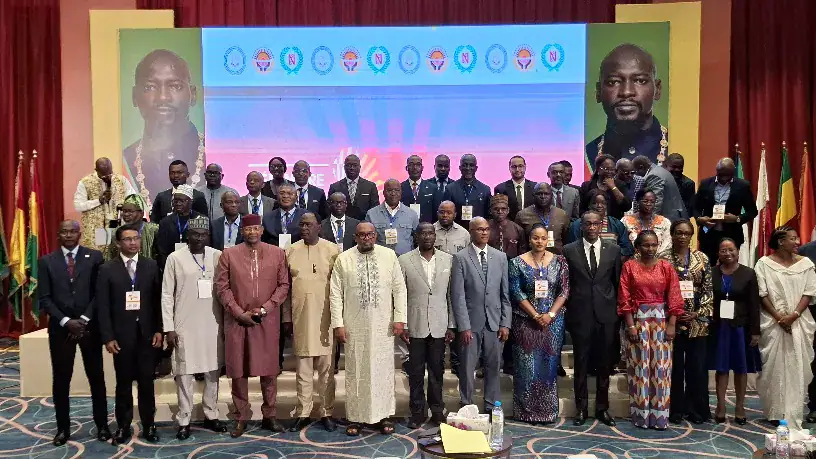
The Guinean capital, Conakry, recently hosted a four-day international seminar focused on expanding social coverage to workers in the informal economy and rural areas. The event, which took place from November 16 to 19, 2026, was organized in collaboration with the Inter-African Conference of Social Security (CIPRES). It brought together 54 participants from eight member states, including the Congo, Côte d'Ivoire, Gabon, Guinea-Bissau, Madagascar, the Democratic Republic of Congo, and Morocco, as well as experts from international organizations.
The seminar aimed to share experiences and identify best practices in social protection. Participants discussed strategies to improve access to social security for populations currently excluded from classical protection systems. The event was placed under the high patronage of the Prime Minister, Amadou Oury Bah, and the Minister of Employment, Labor, and Social Protection, Ramatoulaye Camara. Experts from the International Labor Office (ILO), the International Social Security Association (ISSA), and the World Bank also participated in the discussions.
A key concern addressed during the seminar was the low level of social coverage in the CIPRES region, which has approximately 372 million inhabitants. Data presented showed that only 8.39% of the active population benefits from social coverage, which translates to just 3% of the total population. This situation is particularly worrying given the prevalence of informal employment, which accounts for around 80% of jobs, and the importance of self-employment, estimated at 80.15% of employed individuals.
Participants emphasized the need to rethink social protection mechanisms to make them more accessible to independent workers, informal sector actors, and rural populations. They highlighted the importance of strong political will, adapted legal frameworks, sustainable financing, and better knowledge of target populations. The experiences shared by different countries underscored the role of digitalization, professional organizations, and proximity mechanisms in identifying, registering, and monitoring insured individuals.
The seminar's general synthesis was presented by Marco Andriamanalina, head of the CIPRES support and advisory cell. He noted that the seminar's objective was to allow participating states to compare their experiences, share implemented strategies, and identify concrete solutions adaptable to each country's realities. The discussions covered international and regional concepts and recommendations on social protection, the state of coverage in the CIPRES region, extension strategies, and practical implementation modalities.
Several recommendations emerged from the seminar. Participants suggested disseminating best practices in a community instrument, such as directives, to strengthen member states' commitment. They also recommended greater involvement of finance ministries in reflections on social protection financing, capacity building for institutional actors, and the operationalization of a community of practice dedicated to extending social coverage in the CIPRES region.
The closing ceremony was marked by expressions of gratitude to the Guinean authorities for their hospitality and organizational arrangements. The participants acknowledged the government's engagement and the Ministry of Employment, Labor, and Social Protection's support, which contributed to the seminar's success. The conclusions of the seminar will be presented to President Mamadi Doumbouya, for whom social protection is a priority.
Key points
- The seminar recommended the creation of mixed regimes based on actuarial studies and rigorous analysis of their sustainability.
- Participants emphasized the need for flexible and proportional contribution systems to facilitate access to social protection for informal workers and rural populations.
- The Guinean government plans to use the seminar's conclusions to accelerate reforms and extend social coverage to the Guinean population.