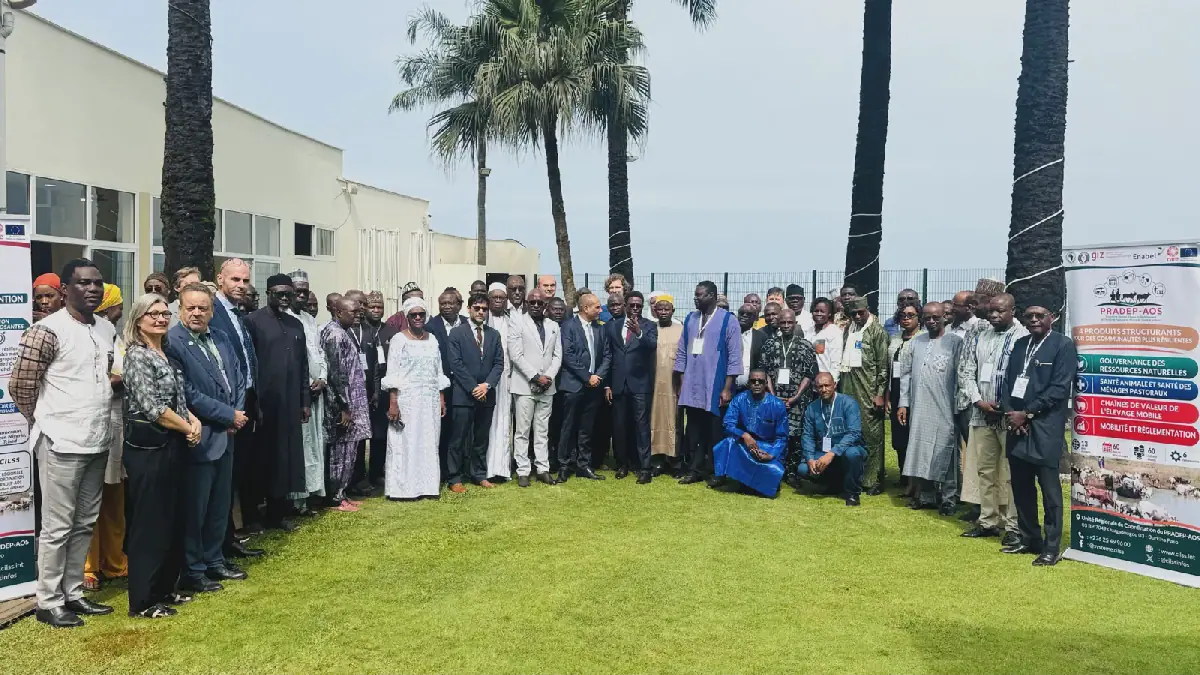
The first session of the Regional Steering Committee for the Regional Program to Support Pastoral Economy Development in West Africa and the Sahel (PRADEP-AOS) opened in Conakry, Guinea, on November 10, 2026. The program aims to strengthen the pastoral economy in the region through better governance of transboundary natural resources, animal health, value chain development, and improved policy and regulatory frameworks. Funded by the European Union with 60 million euros over 60 months, PRADEP-AOS covers 13 countries.
The program was officially launched on July 9, 2026, in Lomé, Togo, and its implementation is crucial for addressing challenges related to climate change, land pressure, access to water and pastures, transboundary animal diseases, and conflicts between farmers and herders. According to Guinea's Minister of Livestock, Alpha Bacar Barry, the program's success relies on collective responses and better consideration of traditional practices in preventing conflicts related to pastoral mobility.
Minister Alpha Bacar Barry emphasized that the pastoral code, or traditional pastoral practices, predates modern states and should be considered when seeking solutions to conflicts. He outlined his department's actions, including securing pastoral spaces, preventing conflicts, and strengthening production and marketing infrastructure for livestock. The minister also announced plans to develop passage corridors to facilitate the movement of livestock from neighboring countries and promote herd stabilization.
The European Union's representative, Gianpiero Borgillo, stressed the need to preserve the program's regional dimension, warning that it should not become a collection of national actions without overall coherence. He called for clear governance, better distribution of responsibilities, and a system of accountability to measure results. Borgillo also emphasized that the session should contribute to defining the program's orientations for 2027, particularly regarding concerted management of constraints related to pastoral mobility.
The program's success depends on several factors, including the quality of dialogue with administrations and pastoral organizations, realistic programming, and clear governance to avoid overlapping responsibilities. Said Karmaoui, country director of the Belgian development agency Enabel in Guinea, highlighted the importance of compatible tools, learning from each other, and responses that consider interactions between territories of departure, transit, and reception.
Representatives of pastoral organizations, such as Abdoul Aziz Ag Alwaly, Secretary-General of the Réseau Billital Maroobé (RBM), drew attention to the difficulties faced by pastoral and agropastoral households in the sub-region, including limited access to water and pastures, mobility restrictions, and health risks. They called for these constraints to be considered in program planning, with priorities, calendars, and means adapted to the needs of different territories.
The first session of the Regional Steering Committee for PRADEP-AOS will continue until November 11, 2026, with participants reviewing the 2026 activity report, examining and validating the 2027 work plan and budget, and discussing synergies with other projects in the pastoral sector. The committee's work will result in a general report, a consolidated planning document for 2027, and a matrix of synergies between different initiatives.
Key points
- The program aims to strengthen the pastoral economy in 13 West African and Sahel countries through better governance of transboundary natural resources and improved policy frameworks.