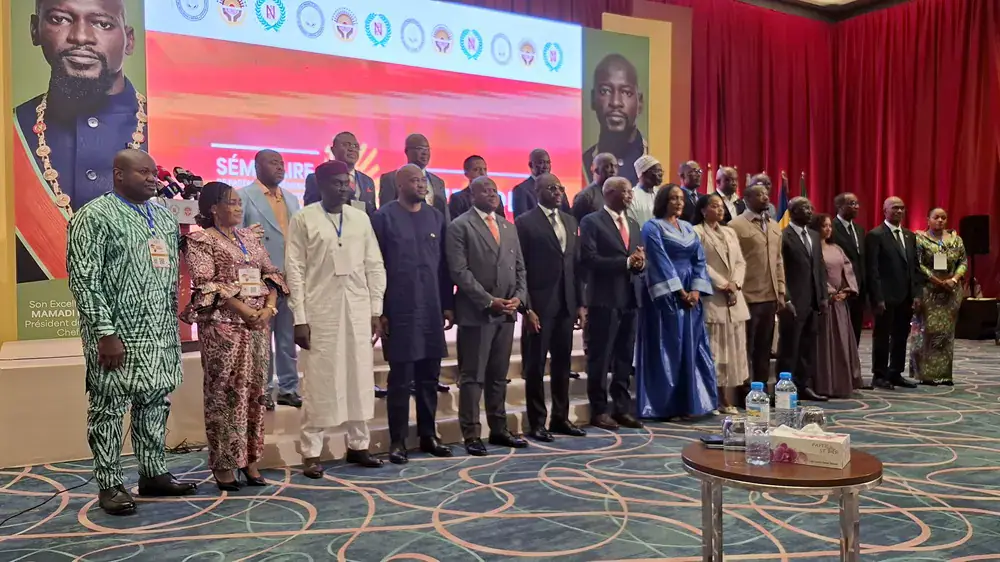
The Guinean capital is hosting a strategic international seminar from November 16 to 19, 2026, focused on expanding social protection to workers in the informal economy and rural areas. The event, organized in collaboration with the Inter-African Conference of Social Security (CIPRES), brings together representatives from 18 member states. The goal is to address one of Africa's major challenges: providing effective and sustainable social protection to millions of workers in the informal and rural sectors.
The seminar's opening session highlighted the urgent need to adapt social security systems to the economic and professional realities of populations largely excluded from classical coverage mechanisms. Bakary Sylla, Director-General of the National Social Security Fund (CNSS), emphasized that the social security system, initially designed for salaried workers, must now be extended to all socio-professional categories, including artisans, farmers, and traders. He cited a 2023 actuarial study with the International Labor Bureau (ILB) that prioritizes coverage for health and old-age risks.
Samira Daoud, representative of the International Labor Organization (ILO) regional office for Africa, recalled that social protection is a fundamental human right and an essential investment in human capital and social cohesion. She noted that, according to the ILO's global report, only one in five people in Africa benefits from at least one social protection benefit. In the CIPRES space, the coverage rate is around 10%. The ILO recommends a two-dimensional approach: a national social protection floor and progressive expansion of benefits.
Sani Mahaman, President of the CIPRES Social Security Supervision Commission, stressed the urgency of adapting regulatory and management systems to labor market realities. He noted that self-employed workers represent over 80% of the employed population in the CIPRES space, with the majority working in the informal sector. The seminar aims to provide a framework for collective intelligence and solution-sharing.
Ramatoulaye Camara, Minister of Employment, Labor, and Social Protection, situated the seminar within the vision of Guinea's sustainable and responsible socio-economic development program, "Simandou 2040", and the social guarantees enshrined in the country's constitution. She outlined three key projects: revising the social security code, extending coverage to informal workers, and ensuring protection for workers on strategic projects, including Simandou.
Prime Minister Amadou Oury Bah launched the seminar, emphasizing that social protection is at the heart of the republican pact and human dignity. He noted that a disease or accident can wipe out a family's life savings, underscoring the importance of state intervention. The Prime Minister highlighted three pillars: economic, political, and social, with the latter being essential for national cohesion.
The four-day seminar aims to produce concrete, pragmatic, and applicable recommendations to strengthen national social protection systems and promote better inclusion of workers excluded from traditional social security systems. The event will focus on rigorous management, financial transparency, and integrating digital tools to improve services for insured individuals.
Key points
- The seminar aims to address the challenge of providing social protection to millions of workers in the informal and rural sectors in Africa.
- The ILO recommends a two-dimensional approach to social protection: a national social protection floor and progressive expansion of benefits.
- The seminar will produce concrete recommendations to strengthen national social protection systems and promote better inclusion of workers excluded from traditional social security systems.