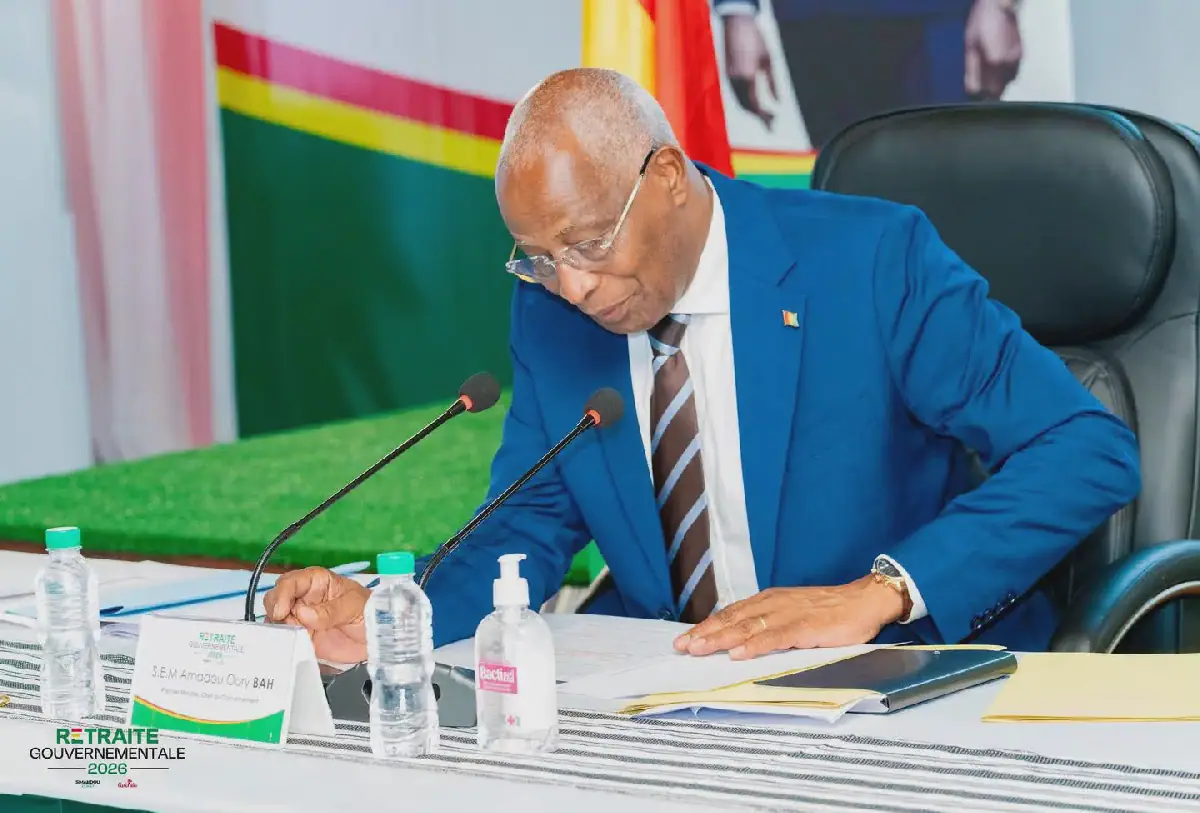
The Guinean government's retreat, held from November 22 to 24, 2026, in Forécariah, has concluded with several key announcements by Prime Minister Amadou Oury Bah. The retreat aimed to strengthen coordination among government ministries and improve performance tracking. The Prime Minister outlined new measures to address challenges faced by various departments and enhance overall governance. These measures include a new oversight mechanism to monitor ministry performance and a strategic doctrine to guide government action.
The retreat's conclusions were presented by Prime Minister Amadou Oury Bah, who emphasized the need for enhanced solidarity and collaboration among government ministries. He noted that the current approach has been too fragmented, hindering effective governance. The Prime Minister highlighted that the three-day retreat allowed for open discussions and identification of common priorities and solutions. He stressed that each ministry's success is interlinked with the success of others.
To implement this new approach, Amadou Oury Bah announced that project bottlenecks will be examined on a ministry-by-ministry basis by the end of 2026. Starting in 2027, the budget program will link each budget credit to a specific responsible individual and measurable outcome. Government instructions will be tracked until full execution. These measures aim to improve accountability and efficiency in government operations.
Another significant announcement was the introduction of mission letters for each ministry, to be implemented in early 2027. These letters will translate common government priorities into specific commitments for each department. The Secretariat General of the Government, in collaboration with the Prime Minister's office, will oversee the tracking of these commitments. The Prime Minister emphasized his personal involvement in resolving reported bottlenecks.
The retreat also saw the approval of Guinea's economic and financial program for 2026-2029 by the International Monetary Fund (IMF) on November 23. Amadou Oury Bah attributed this decision to ongoing reforms and the hard work of government teams. He noted that this approval increases the government's obligation to deliver concrete results for the population.
A key highlight of the retreat's closing ceremony was the launch of the "Doctrine Mamadi Doumbouya: Strategic Neutrality for Sustainable Stability." This doctrine is presented as a guiding framework for government action, emphasizing national sovereignty, neutrality in international rivalries, and cooperation with all partners without dependence on any one of them. The doctrine aims to focus Guinea's resources on economic transformation and improving living conditions.
The "Doctrine Mamadi Doumbouya" is built on Guinea's historical, cultural, and institutional heritage, with a focus on national identity and the 1958 national choice. Prime Minister Amadou Oury Bah stated that this doctrine will guide government decisions and actions, providing a roadmap for ministers, a code of conduct for public servants, and a source of national pride for citizens. The Simandou 2040 program is cited as one of the key initiatives under this doctrine.
Key points
- The Guinean government has introduced a new oversight mechanism to monitor ministry performance and launched the "Doctrine Mamadi Doumbouya" to guide government action.
- The new measures aim to enhance coordination, accountability, and efficiency in government operations.
- The "Doctrine Mamadi Doumbouya" emphasizes national sovereignty, strategic neutrality, and cooperation with all partners without dependence on any one of them.