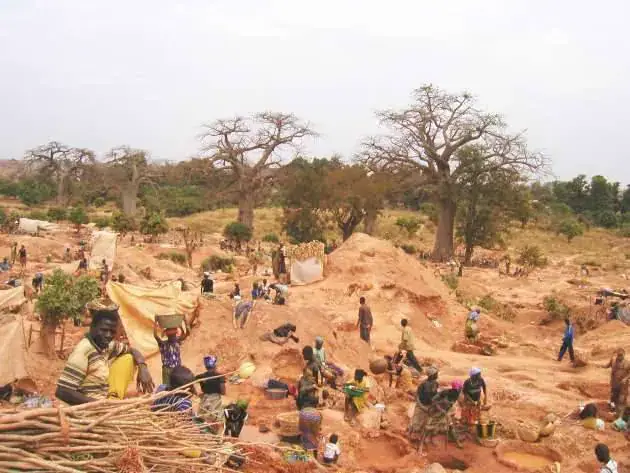
The Guinean government has taken a firm stance against unregulated gold mining in the Siguiri region, deploying military forces to combat the practice. Following several inspection missions that revealed significant environmental degradation, the government has announced a total ban on unregulated gold mining and the permanent deployment of defense and security forces in the area. This decision was formalized in a joint communiqué signed by several ministers, including those responsible for defense, security, environment, and mining.
The inspection missions, conducted over the past few months, found alarming environmental degradation due to unregulated gold mining by artisanal operators who fail to respect existing regulations. The use of heavy machinery has resulted in the destruction of soils, agricultural lands, and vegetation, as well as pollution and siltation of the Niger River, Djoliba, Tinkisso, and their tributaries, a zone of international importance. The government has subsequently banned the use of dredges and the extraction or washing of minerals in riverbeds or on riverbanks.
The government has also prohibited the use of explosives, mercury, cyanide, and other hazardous chemicals in gold mining. Furthermore, mining is now banned in riverbeds, on riverbanks, agricultural lands, pastures, protected areas, classified forests, and near populated areas and public infrastructure. To enforce these measures, the government has deployed a range of defense and security units, including army, gendarmerie, police, customs, and nature conservation corps, to monitor the area and control access points.
The deployed units will verify the identity and regularity of stay of individuals present on the sites, and foreigners in irregular situations will be subject to procedures provided by law. The government has warned that any tolerance, complicity, or illicit exploitation of gold will be sanctioned, and the purchase and sale of gold produced in the region are only authorized through accredited gold buying centers. Those found violating these measures will face sanctions and judicial prosecution.
The government has established a system of control and monitoring, with the Commission régionale de défense et de sécurité and other local commissions responsible for implementing and monitoring the measures. These commissions are required to submit weekly reports to the Commission nationale de défense et de sécurité. Local authorities, district presidents, and sector chiefs are personally responsible for ensuring compliance with the measures in their areas.
The government has emphasized that these measures do not undermine the importance of the gold sector in the national economy but aim to protect human lives, preserve the environment, and ensure that mineral resources are exploited in accordance with the laws of the Republic and the principles of sustainable development. The authorities have called on local populations, customary and religious leaders, youth and women's organizations, and mining operators to cooperate with the authorities and report any illegal activities.
The deployment of military forces and the implementation of strict controls are expected to bring an end to unregulated gold mining in the Siguiri region, which has caused significant environmental degradation and safety concerns. The government's efforts to balance economic development with environmental protection and human safety are seen as crucial to the sustainable development of Guinea's mining sector.
Key points
- The Guinean government has deployed military forces to Siguiri to combat unregulated gold mining and enforce environmental regulations.
- The ban on unregulated gold mining includes the prohibition of heavy machinery, explosives, and hazardous chemicals.
- The government has established a system of control and monitoring to ensure compliance with the measures.