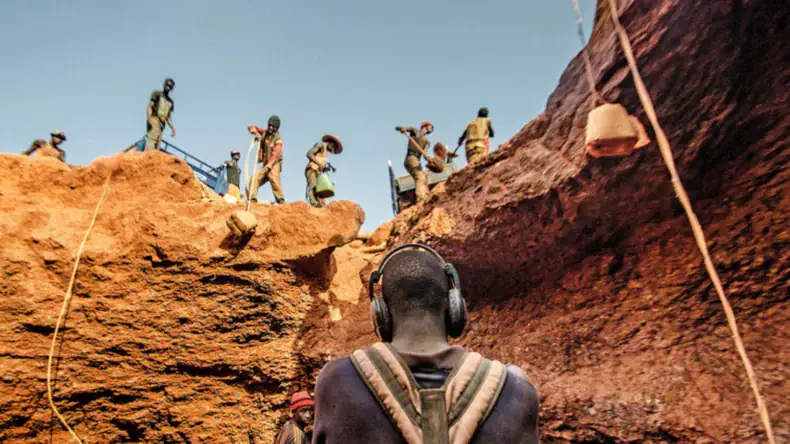
The Guinean authorities have launched a major crackdown on illegal gold mining in the northeastern region of Siguiri, arresting 1,263 people, including citizens of Guinea and nationals from several other West African countries. The arrests were made as part of a joint operation by the Ministries of National Defense and Public Security, aimed at curbing the exploitation of gold in the region. Those arrested were taken to the capital city of Conakry for questioning by judicial police and gendarmerie before being brought before the courts.
The operation, which began on November 2, is aimed at stopping the degradation of soil, destruction of agricultural land, and chemical pollution of waterways caused by the use of mercury and cyanide in artisanal gold mining. The Guinean government has also taken steps to sanction administrative officials accused of complicity in the illegal mining activities. By presidential decree, 22 territorial administrators, including the interim governor, four prefects, and 17 sub-prefects, were dismissed from the civil service, while 479 district and neighborhood presidents were revoked and referred to justice.
The crackdown on illegal gold mining has significant economic implications for Guinea, which produced 72 tons of gold in 2024, with 70% of it coming from the artisanal sector. The government is seeking to better regulate the mining sector and prevent the environmental damage caused by uncontrolled mining activities. The operation has also had transborder repercussions, particularly in neighboring Mali, where authorities have reported the arrival of around 160,000 people expelled from Guinean territory since the beginning of the interventions.
The situation in Mali has been described as an "humanitarian emergency" by the Bamako authorities, who have reported six deaths. The Guinean authorities have reaffirmed their determination to pursue any individual involved in the illegal exploitation of mining resources, regardless of their nationality. The crackdown is ongoing in the prefectures of Mandiana, Kérouané, and Kouroussa, with the authorities vowing to take a firm stance against those involved in the illicit trade.
The Guinean government's efforts to regulate the mining sector have been welcomed by environmental and human rights groups, who have long raised concerns about the impact of artisanal gold mining on local communities and the environment. However, the operation has also raised concerns about the impact on local livelihoods, with many people in the region relying on small-scale mining for their income.
The authorities have announced plans to establish a new regulatory framework for the mining sector, which will aim to ensure that mining activities are carried out in a responsible and sustainable manner. The framework will also provide for the creation of a national mining agency, which will be responsible for monitoring and enforcing mining regulations.
As the situation continues to unfold, the Guinean government has urged calm and cooperation from local communities, while also warning that it will take a firm stance against those who continue to engage in illegal mining activities. The international community has been watching the developments closely, with many countries and organizations expressing support for Guinea's efforts to regulate its mining sector and protect its environment.
Key points
- 1,263 people arrested in Guinea's crackdown on illegal gold mining
- Guinea produced 72 tons of gold in 2024, with 70% from the artisanal sector
- The crackdown has caused a humanitarian emergency in neighboring Mali, with 160,000 people expelled from Guinean territory
Reporting sources
- Guinée : plus de 1200 personnes interpellées dans une opération contre l’orpaillage illégal · Le Quotidien de Nouakchott