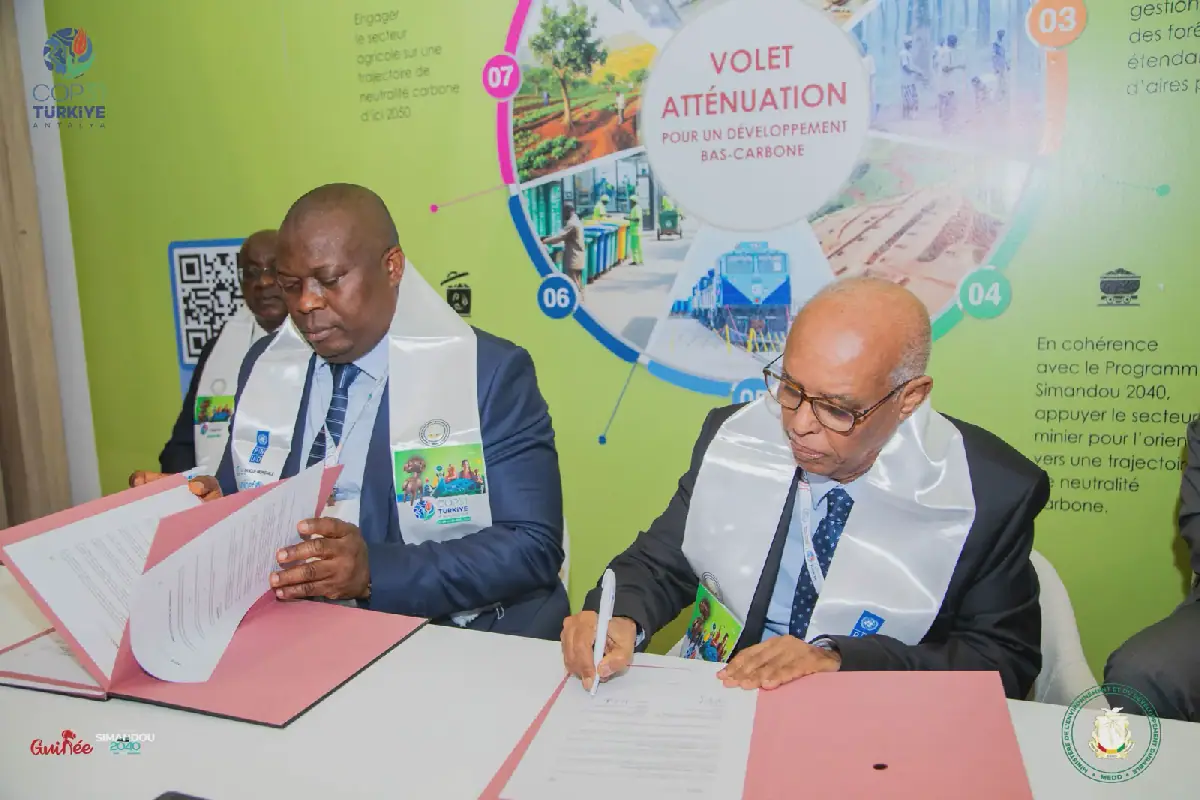
The Republic of Guinea and the Republic of Djibouti have concluded a cooperation agreement on the exchange of experiences relating to Sovereign Carbon Initiatives and the development of carbon markets. The agreement was signed by H.E. Fassou Théa, Minister of Environment and Sustainable Development of the Republic of Guinea, and H.E. Mohamed Ahmed Awaleh, Minister of Environment and Sustainable Development of the Republic of Djibouti. This commitment aims to strengthen technical and institutional cooperation, facilitate the sharing of expertise, and promote the development of harmonised Sovereign Carbon Initiatives tailored to their respective national priorities.
In 2023, Djibouti launched the first Sovereign Carbon Initiative on the African continent, based on the polluter-pays principle and inspired by internationally implemented mechanisms. This initiative requires a contribution from greenhouse gas emitters in the maritime transport and aviation sectors to support climate change adaptation efforts, ecological and energy transition in the countries where they operate. The pioneering initiative has inspired similar developments in Gabon in 2025 and Liberia, with the support of the Africa Sovereign Carbon Registry Foundation.
The progressive adoption of this common approach by several countries reflects the emergence of an African coalition in support of climate justice, carbon sovereignty, and increased access to climate finance. This agreement between Guinea and Djibouti illustrates the growing determination of African nations to strengthen their South-South cooperation in order to promote solutions that facilitate access to climate finance, unlock the continent’s carbon potential, and reinforce national sovereignty as part of a shared commitment to climate justice.
The agreement between Guinea and Djibouti demonstrates the willingness of African countries to advance concrete, operational, and harmonised solutions in the fields of climate finance and carbon sovereignty. As Africa prepares to host COP32 in Addis Ababa in 2027, this growing momentum shows that countries are working together to address climate change and promote sustainable development.
The Africa Sovereign Carbon Registry Foundation works to promote a harmonised mechanism across the African continent. The foundation's efforts aim to support countries in developing their own Sovereign Carbon Initiatives, tailored to their national priorities and circumstances. By promoting a harmonised approach, the foundation seeks to facilitate the development of carbon markets and increase access to climate finance for African countries.
The cooperation agreement between Guinea and Djibouti is a significant step towards achieving the goals of the Paris Agreement and the Sustainable Development Goals. By working together, African countries can leverage their collective strength to address the challenges of climate change, promote sustainable development, and ensure a more equitable future for all.
As the African continent continues to develop and implement Sovereign Carbon Initiatives, it is likely that we will see increased cooperation and coordination among countries. This cooperation will be essential in addressing the global challenge of climate change and promoting sustainable development. With the support of initiatives like the Africa Sovereign Carbon Registry Foundation, African countries can work together to achieve their climate and development goals.
Key points
- The agreement between Guinea and Djibouti aims to strengthen technical and institutional cooperation on Sovereign Carbon Initiatives and carbon market development.
- Djibouti launched the first Sovereign Carbon Initiative on the African continent in 2023, which has inspired similar developments in other countries.
- The emergence of an African coalition in support of climate justice, carbon sovereignty, and increased access to climate finance reflects a growing determination among African nations to address climate change and promote sustainable development.