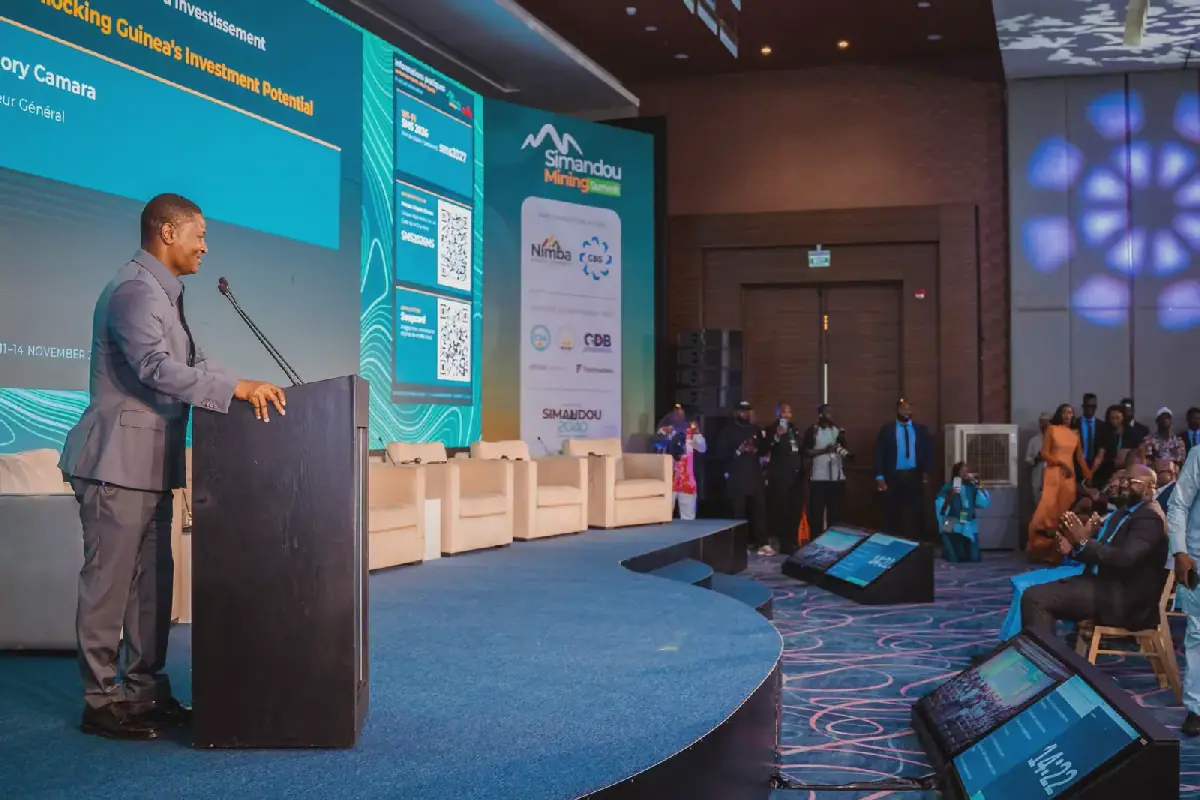
The Guinean government is seeking to capitalize on the momentum generated by the Simandou project to attract more investments and accelerate economic diversification. Namory Camara, Director-General of the Guinea Development Board (GDB), presented the country's advantages, investment opportunities, and business climate reforms at the Simandou Mining Summit in Conakry. He announced that the first phase of the Simandou 2040 program, covering 2025-2030, expects around $65 billion in investments, with 40% anticipated from the private sector.
Camara highlighted Guinea's strategic geographical position, natural resources, and dynamic population as key advantages. The country has 330 kilometers of coastline and shares borders with six countries, providing direct access to a sub-regional market of 64 million consumers, which is part of a larger West African market of over 400 million people through the Economic Community of West African States (ECOWAS). Additionally, Guinea has significant natural resources, including bauxite reserves, iron ore, an estimated 6,000 megawatts of hydroelectric potential, and over 13 million hectares of arable land.
The Director-General of the GDB emphasized that Guinea is currently experiencing a favorable period for investment, driven by the development of the Simandou project. The country has achieved an economic growth rate of 8.8%, with prospects of two-digit growth in 2027. Camara also mentioned Guinea's first sovereign rating by Standard & Poor's, established at B+ with a stable outlook in September 2025, and then positive in March 2026. Furthermore, the country attracted $7.8 billion in foreign direct investments (FDIs) in 2025, ranking second in Africa behind Egypt.
Despite these advantages, Camara acknowledged that Guinea's economy is heavily dependent on the mining sector, which poses a significant challenge. He cited the example of Botswana, which faced competition from synthetic diamonds, and advocated for diversification to reduce the risks associated with the concentration of economic activities around extractive resources. The GDB Director-General stressed that diversification is a priority, aiming to develop new sectors, broaden the economic base, and create more value-added jobs in Guinea.
The Simandou 2040 program is structured around five pillars, 14 priority sectors, 122 megaprojects, and 36 reforms, with a total investment envelope of over $200 billion over 15 years. The first phase, covering 2025-2030, represents around $65 billion in expected investments, with 40% anticipated from the private sector, approximately $26 billion. Camara stated that the challenge now is to convert this ambition into structuring projects and investment decisions. To this end, projects worth over $5 billion are being presented to investors in dedicated Deal Rooms.
The objectives announced for 2030 include the establishment of 4,000 megawatts of energy capacity, the development of 850 kilometers of highways, the construction of 50,000 housing units per year, the deployment of two additional submarine cables, and the development of seven industrial sites capable of generating 90,000 jobs. Camara also announced that three aluminum refineries are currently under construction in Guinea. The energy sector, in particular, offers significant opportunities, driven by the demand for reliable and competitive electricity from future aluminum refineries and industrial poles.
The development of the Simandou corridor, a 650-kilometer railway, is expected to spur the emergence of new cities, logistics platforms, agro-industrial activities, and services. Camara drew a parallel with the development generated by similar infrastructure projects, highlighting the potential for economic growth and job creation. By diversifying its economy and leveraging its natural resources, Guinea aims to reduce its dependence on the mining sector and create a more sustainable and inclusive growth model.
Key points
- Guinea targets $65 billion in investments by 2030, with 40% expected from the private sector.
- The country's Simandou 2040 program aims to diversify the economy and reduce dependence on the mining sector.
- Guinea has attracted $7.8 billion in foreign direct investments (FDIs) in 2025, ranking second in Africa behind Egypt.