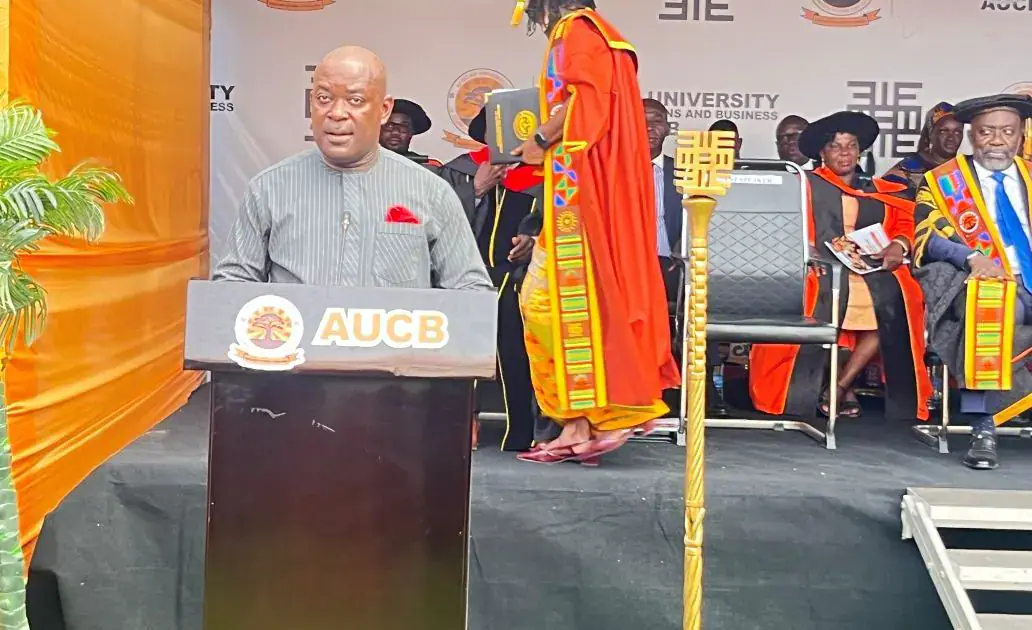
The Ghana Tertiary Education Commission (GTEC) has cautioned universities in Ghana against admitting more doctoral candidates than their institutional capacity can support. This warning was given by Professor Ahmed Abdulai Jinapor, the Director-General of GTEC, during the graduation ceremony of the African University of Communication and Business in Accra on Saturday, 31 October 2026. He emphasized that the expansion of doctoral programmes must be matched with adequate numbers of qualified supervisors, research infrastructure, library resources, and funding.
Professor Jinapor stressed that doctoral education is critical to producing the next generation of researchers, lecturers, and policy thinkers. However, he warned that institutions must not compromise academic standards in the quest to increase enrolment. A total of 350 students graduated from the African University of Communication and Business, comprising 206 undergraduates and 144 postgraduate students. The graduation ceremony was held on the theme “Transforming Higher Education for a Resilient Nation: Leveraging Technology for Sustainable Development.”
The Director-General of GTEC urged all universities, particularly newly chartered institutions, to align doctoral admissions with their actual capacity. He emphasized that quality rather than quantity must define doctoral education in the country. Professor Jinapor noted that doctoral qualifications represent years of rigorous study, original research, and examination and must not be treated as commercial products. He added that growth in numbers must never outpace capacity.
Professor Jinapor also touched on the theme of the graduation ceremony, stating that universities must rethink their teaching, research, and engagement with industry to prepare graduates for an increasingly technology-driven world. He noted that artificial intelligence, automation, big data, digital platforms, and cybersecurity are transforming professional and economic activities. Therefore, it is imperative for higher education institutions to equip students with relevant skills.
The Director-General of GTEC also discussed the importance of online, blended, and distance learning in widening access to tertiary education. He noted that these modes of learning offer opportunities for working people, persons in remote communities, and persons with disabilities. However, Professor Jinapor warned that digital education must not become a shortcut to lower academic standards. He emphasized that degrees obtained through online learning must carry the same value as those awarded through traditional campus-based programmes.
Professor Jinapor advised the graduates to embrace lifelong learning and acquire the skills to work effectively with emerging technologies, particularly artificial intelligence. He encouraged them to develop the ability to analyse data, distinguish credible information from misinformation, and adapt to changes in their respective professions. The Director-General also cautioned them against allowing technology to replace independent thinking, integrity, and sound judgment.
Finally, the Director-General of GTEC disclosed that the Commission had intensified public education on recognised institutions and accredited learning centres to protect prospective students from enrolling in unrecognised institutions. He urged the public to exercise due diligence before enrolling in tertiary programmes. The Overall Best Graduating Student, Faculty of Strategic Communication, Ms Barbara Kafui Abram, encouraged the graduates to remain determined in the pursuit of their ambitions.
Key points
- GTEC cautions universities against admitting doctoral candidates beyond their capacity.
- Director-General of GTEC emphasizes the importance of quality over quantity in doctoral education.
- GTEC intensifies public education on recognised institutions and accredited learning centres.