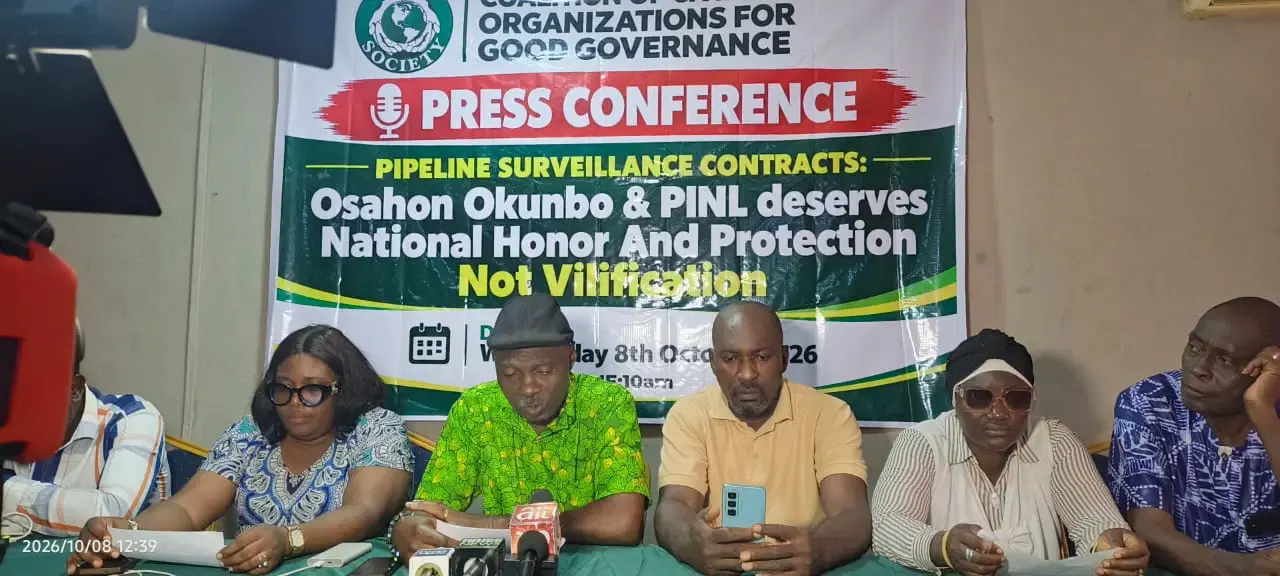
The Coalition of Civil Society Organisations for Good Governance (CCSOGG) has urged stakeholders to demand evidence-based assessments of surveillance contracts for pipelines in the Niger Delta. This call comes amid allegations surrounding the value and performance of the Pipeline Infrastructure Nigeria Limited (PINL) and its Project Director, Osahon Okunbo. CCSOGG's spokesman, Comrade Declan Ihekaire, emphasized the need for verifiable evidence to address legitimate questions about government contracts.
CCSOGG has expressed concern over the renewed controversy surrounding pipeline surveillance contracts in the Niger Delta, particularly allegations against PINL and Okunbo. The coalition stressed that public accountability must be based on facts, documents, and verifiable evidence, rather than sensational allegations that could damage reputations and undermine national security operations. They rejected claims of a fictitious ₦2.7 trillion personal pipeline surveillance arrangement.
The coalition argued that if there are questions about government expenditure, the relevant authorities should publish contracts, payment schedules, scope of work, and performance records. This, they believe, would allow Nigerians to scrutinize the information. CCSOGG finds it unacceptable to circulate figures without documentary evidence and use them to blackmail individuals. They highlighted the ₦2.7 trillion figure associated with PINL and Okunbo as a particular concern.
CCSOGG demanded that if the allegation is true, the documents should be produced as evidence. If not, those responsible for spreading the information must correct the record. The coalition emphasized the dangers of casually attaching such a large figure to a named individual involved in a sensitive national security assignment, which could expose them to hostility and security risks.
The group examined available information surrounding the PINL arrangement and clarified that the figure being bandied about lacks credible documentary evidence. Recent reports have also noted the absence of publicly presented contract or payment records supporting the ₦2.7 trillion allegation. CCSOGG insisted on a simple standard: producing documents to support claims or correcting the record if allegations are false.
CCSOGG's call for an evidence-based assessment aims to promote transparency and accountability in the management of pipeline surveillance contracts. By insisting on verifiable evidence, the coalition seeks to prevent the spread of misinformation and protect individuals and communities from unnecessary risks. This approach would ensure that discussions around public contracts are constructive and based on facts.
The controversy surrounding pipeline surveillance contracts in the Niger Delta highlights the need for transparent and accountable management of national security operations. CCSOGG's stance underscores the importance of evidence-based evaluations in preventing the spread of misinformation and promoting public trust. The coalition's demand for documentary evidence to support allegations aims to foster a more informed and responsible public discourse.
Key points
- CCSOGG calls for evidence-based assessment of pipeline surveillance contracts
- Coalition rejects ₦2.7 trillion allegation against PINL and Osahon Okunbo
- Group demands documentary evidence to support allegations or correction of the record