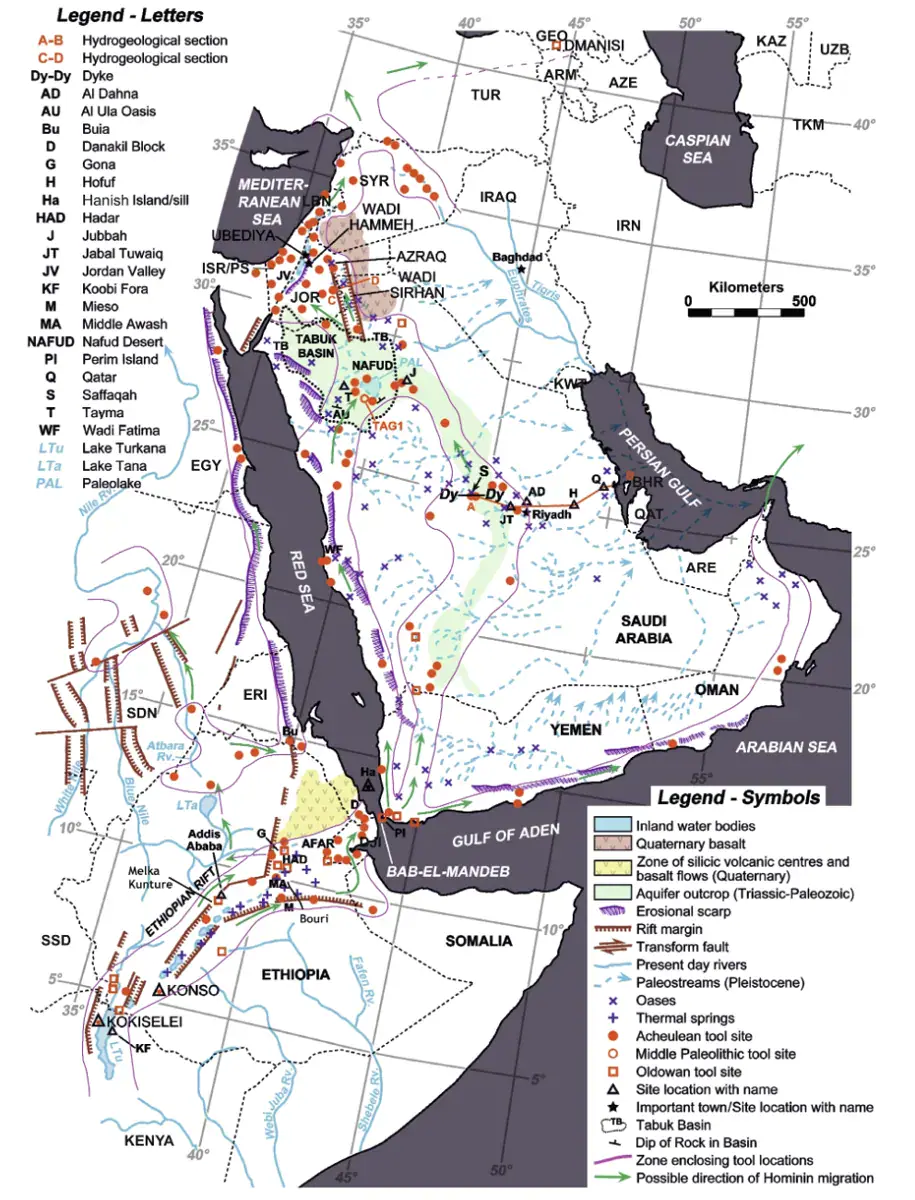
Around two million years ago, early humans such as Homo erectus began migrating beyond East Africa in search of new territories and reliable sources of water. A new study published in Hydrogeology Journal suggests that groundwater and springs may have played a crucial role in these early migrations, potentially helping explain which routes were accessible from East Africa through the Arabian Peninsula and into Eurasia. The study's findings highlight the importance of water in discussions of human evolution.
The researchers, including Mark Cuthbert, professor of Earth and environmental sciences at Cardiff University, reviewed published evidence from fossils, stone tools, ancient springs and lakes to investigate the role of water in early human migration. They reconstructed the water landscapes of East Africa and Arabia to identify locations where water may have remained available even after rivers and lakes dried up. This approach allowed them to identify potential water refuges within otherwise increasingly inhospitable landscapes.
According to the study, surface water responds relatively quickly to declining rainfall, while large underground water reservoirs can continue feeding springs for thousands of years after a dry period begins. Some springs in East Africa may have remained active for hundreds or even thousands of years during the driest phases of climate cycles, creating water refuges. The earliest evidence of groundwater use by human ancestors dates back approximately 4.4 million years in East Africa, including wet environments near springs and groundwater sources in Ethiopia.
In Tanzania, evidence dating back around 1.8 million years includes stone tools and early human remains found near wetlands and freshwater springs beside a saline lake unsuitable for drinking. Cuthbert suggests that early humans may have learned to locate water by observing animals with greater experience finding it, including elephants and some primates. They may also have dug shallow wells by hand in dry riverbeds to reach water trapped beneath the sand.
The study proposes that early humans may have followed a southern route when leaving Africa, crossing the Bab el-Mandeb Strait between present-day Djibouti and Yemen, rather than the traditionally proposed route through the Nile Valley and Sinai. The researchers argue that the Nile was not necessarily a permanent, continuously flowing river in its present form between approximately 1.8 million and 800,000 years ago. Lower sea levels may have reduced the crossing distance to approximately 10 kilometres at certain times.
Once early humans reached Arabia, they may not have needed to wait for every new wet period before continuing their journeys. Large underground aquifers extending beneath the peninsula could have supplied a network of springs and oases during prolonged dry periods. The study highlights a water-bearing geological formation stretching approximately 1,500 kilometres across Arabia, near areas containing substantial concentrations of stone tools in Saudi Arabia.
The proposed migration route continues northward through Wadi Sirhan in Saudi Arabia, where Acheulean archaeological sites occur near springs and groundwater reservoirs, before extending towards the Azraq Oasis in Jordan and the Jordan Valley. The researchers argue that understanding how groundwater behaved during ancient climate changes could provide an important missing piece in reconstructing the earliest movements of humans beyond Africa.
Key points
- Groundwater and springs may have played a crucial role in early human migration from Africa to Eurasia.
- The study proposes a southern route through the Bab el-Mandeb Strait, rather than the traditionally proposed route through the Nile Valley and Sinai.
- Large underground aquifers in Arabia could have supplied a network of springs and oases during prolonged dry periods.
Reporting sources
- Did groundwater help early humans migrate out of Africa through Arabia? · Daily News Egypt