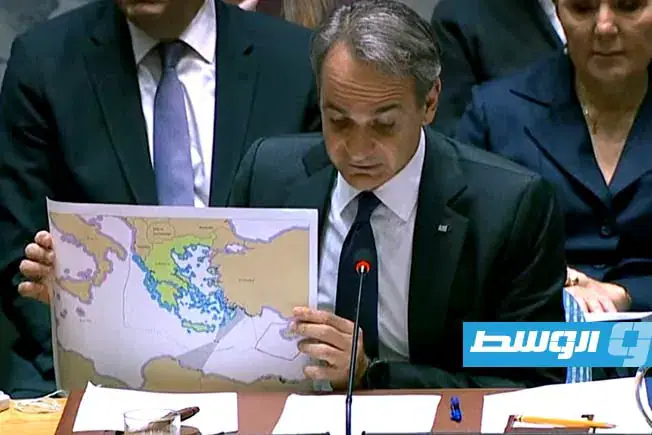
Greek Prime Minister Kyriakos Mitsotakis has denounced a maritime border agreement between Libya and Turkey as "absurd" and "illegal". Speaking at an open discussion of the UN Security Council, Mitsotakis stated that the agreement violates fundamental principles of international maritime law. He emphasized that Greece and Libya are neighboring countries with opposite coastlines and have the right to demarcate their maritime zones by agreement.
Mitsotakis highlighted that Turkey and Libya do not share a common coastline or adjacent coastlines, making their attempt to establish a maritime border "absurd". He presented a map to clarify Greece's stance on the issue, noting that islands like Crete, Rhodes, and Karpathos are not "uninhabited rocks in the middle of the sea". Mitsotakis referenced the agreement on maritime border demarcation between Greece and Egypt as a model for establishing such boundaries.
The Greek Prime Minister expressed concerns that the Turkey-Libya agreement could delay the implementation of a maritime connection project between Greece, Cyprus, and Israel. He also noted that the agreement undermines regional alliances and rekindles debates about the Eastern Mediterranean. Mitsotakis stressed that geography cannot be altered by drawing arbitrary lines on a map.
The maritime border agreement between Turkey and Libya was signed in 2019 and recently approved by the Libyan House of Representatives. Greece, Cyprus, Egypt, Israel, and France have rejected the agreement, citing concerns about regional security. Mitsotakis' statements reflect Greece's firm stance on the issue, emphasizing the need for agreements to be based on international law and geography.
The UN Security Council discussion, chaired by Greece, focused on emerging technologies and maritime security. Mitsotakis' participation in the discussion underscored Greece's commitment to addressing regional security challenges. The issue of maritime borders in the Eastern Mediterranean remains a contentious topic, with various countries vying for influence and resources in the region.
The Libyan-Turkish maritime border agreement has sparked concerns about the potential for increased tensions in the region. Egypt, Bahrain, the UAE, and Greece have issued a joint statement expressing their concerns about the agreement, citing its threat to regional security. The agreement's implications for regional dynamics and international relations remain to be seen.
The developments surrounding the Libya-Turkey maritime border agreement highlight the complexities of regional politics and the need for diplomatic solutions. As countries in the region navigate their relationships and interests, the international community will be watching closely for any signs of escalation or resolution. The situation remains fluid, with various stakeholders engaged in efforts to address the challenges posed by the agreement.
Key points
- The agreement undermines regional alliances and rekindles debates about the Eastern Mediterranean.
- Greece and Libya are neighboring countries with opposite coastlines and have the right to demarcate their maritime zones by agreement.
- The Libya-Turkey maritime border agreement was signed in 2019 and recently approved by the Libyan House of Representatives.