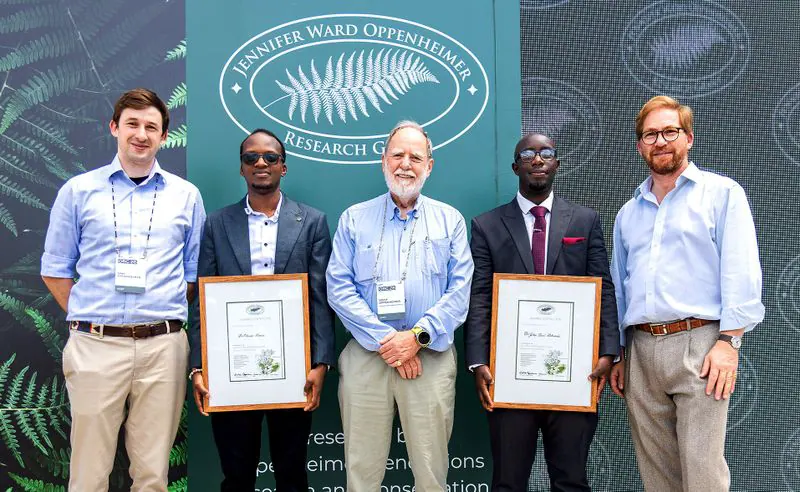
Dr John Paul Makumbi, a Ugandan microbiologist, and Dr Olivier Jean Leonce Manzi, a Rwandan tree physiologist, have been jointly awarded the 2026 Jennifer Ward Oppenheimer Research Grant. Each will receive $150,000 to support their research projects. Makumbi's project focuses on using microbial DNA to detect early signs of environmental change in Africa's freshwater systems. Manzi's research explores the internal physiology of tropical trees to understand their response to stress. The grant, established in memory of Jennifer Ward Oppenheimer, supports transformative African-led research.
Makumbi's research addresses the growing pressure on Africa's freshwater systems, including the East African Great Lakes, which hold about a quarter of the world's unfrozen surface water. He aims to develop a predictive early warning toolkit to identify ecosystems approaching a tipping point. By tracking molecular signals in microbial DNA, Makumbi hopes to provide objective, actionable data for policymakers and law enforcement. This approach could help identify the sources of environmental stress and cut through blame that often paralyses efforts to address pollution.
Makumbi's project will focus on four families of genomic indicators: genes involved in biogeochemical processes, pathways associated with stress and pollution responses, mobile genetic elements, and networks of interactions within microbial communities. The aim is to test these indicators across sentinel sites in Uganda's Lake Victoria, Côte d'Ivoire's Ébrié Lagoon, Ethiopia's Blue Nile, South Africa, and Eswatini. This research could have practical benefits, such as helping to identify the sources of environmental stress and providing data to support conservation efforts.
Manzi's research explores the internal physiology of tropical trees to understand their response to stress. Growing up in Rwanda, Manzi was raised near a lush natural forest, but when he returned years later, much of the forest had been cleared. His research question is parallel to Makumbi's: what happens inside trees before the stress becomes visible? Manzi's project involves studying tree species in a forest restoration trial plot in Rwanda to understand their different responses to stress.
Manzi's observation of a plantation in Rwanda, where some tree species were healthy while others were dying back, led him to question what was happening inside the trees. He compares it to people living under similar conditions, yet responding differently to the same stress. Manzi's research aims to understand the internal physiology of trees and how they respond to stress, which could inform conservation and restoration efforts.
The Jennifer Ward Oppenheimer Research Grant was presented by three generations of the Oppenheimer family. The grant supports African-led research that has the potential to transform our understanding of the environment. Makumbi and Manzi's research projects have the potential to inform conservation and restoration efforts across Africa.
The research projects of Makumbi and Manzi have significant implications for Africa's environmental future. By exploring the microscopic organisms living in Africa's waters and the internal physiology of tropical trees, they aim to provide early warning signs of environmental change. Their research could inform policy and conservation efforts, ultimately contributing to a more sustainable future for Africa's ecosystems.
Key points
- Dr John Paul Makumbi and Dr Olivier Jean Leonce Manzi have been awarded the 2026 Jennifer Ward Oppenheimer Research Grant to support their research projects on microbial DNA and tropical tree physiology.
- Makumbi's research focuses on using microbial DNA to detect early signs of environmental change in Africa's freshwater systems.
- Manzi's research explores the internal physiology of tropical trees to understand their response to stress.