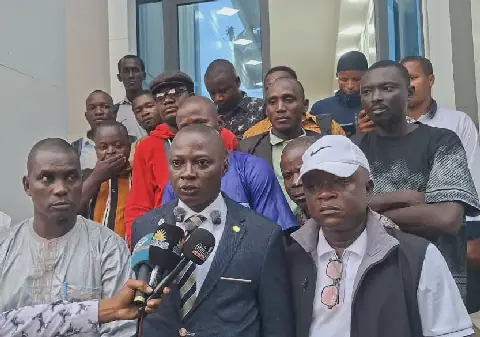
A Development Practitioner, Mr Douglas Quartey, has called on the Government to reconsider its position on non-partisan District Assembly Elections. He argues that the growing call for elected Metropolitan, Municipal and District Chief Executives is not simply about adding another election to Ghana’s calendar, but about making local executives directly accountable to citizens. Mr Quartey made these comments at an IDEG-Oxfam Citizens’ Forum in Accra on local governance and decentralisation reforms.
Mr Quartey noted that although the Government’s position paper maintained the non-partisan nature of District Assembly Elections, Ghana’s political reality had moved beyond that position. He cited the 2024 Afrobarometer survey, which showed that 47.6 per cent of respondents supported changing the law to allow Assembly members to contest on political party platforms. This is compared with 43.5 per cent who disagreed with the change.
Professor Joseph Atsu Ayee of the Department of Political Science, University of Ghana, reinforced Mr Quartey's concerns. He described the notion that local governance was free from political party participation as a “charade”. Professor Ayee argued that political party influence already existed within the system and should therefore be openly acknowledged and properly regulated.
Similar concerns about the effectiveness of Ghana’s local governance system have been expressed by public officials. Justice Sir Dennis Dominic Adjei called for a bold national decision on whether political parties should be formally allowed to participate in District Assembly Elections. This sentiment was also echoed by Mr Haruna Iddrisu, Minister of Education and Member of Parliament for Tamale South.
The concerns were re-echoed at the Citizens’ Forum, themed: “Constitutional Reform and Democratic Decentralisation in Ghana: The Way Forward for Local Governance.” The forum brought together representatives from civil society organisations, women’s groups, youth, academia and development partners to discuss practical solutions to challenges confronting Ghana’s local governance system.
Discussions at the forum highlighted persistent shortcomings in the country’s decentralisation framework. Stakeholders called for a re-examination of the constitutional and legal foundations of local government to better align the system with citizen participation, accountability and local development outcomes.
The forum's outcome is expected to contribute to the ongoing national conversation on Ghana's local governance system. Key stakeholders are advocating for a re-examination of the current non-partisan system and consideration of a more inclusive and participatory approach to local governance.
Key points
- The government is being urged to reconsider its stance on non-partisan local elections.
- Experts argue that political parties already influence local-level elections.
- A national conversation on the issue is ongoing, with stakeholders calling for a more inclusive and participatory approach to local governance.