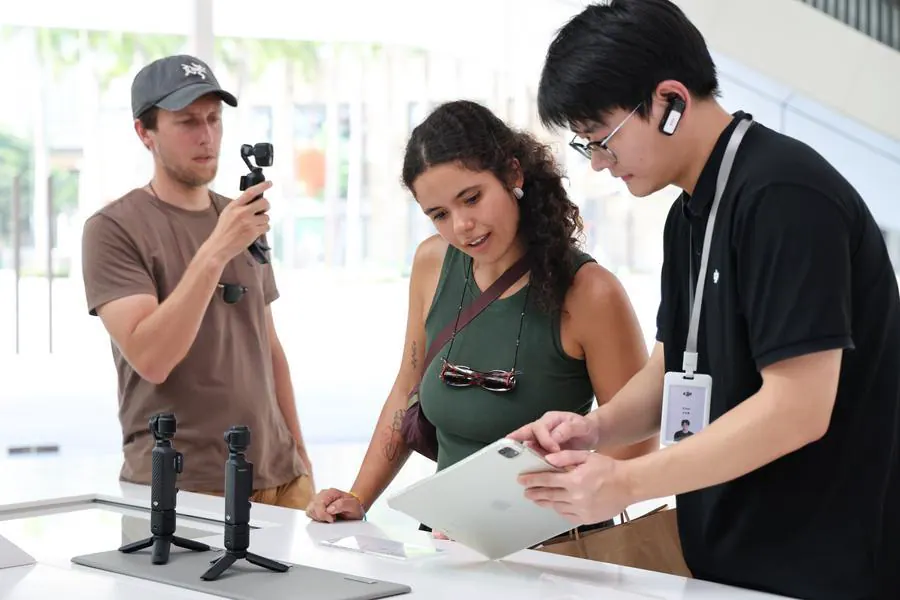
The phenomenon of "China Haul" has taken the world by storm, with travelers flocking to China not just for sightseeing, but for an unparalleled shopping experience. According to the Ministry of Commerce, in the first seven months of 2026, people from overseas spent 263.6 billion yuan, an increase of 27.8 percent year on year. This surge in spending has been driven by the country's reputation for producing high-quality, affordable products that cater to diverse tastes and preferences.
Shenzhen, a thriving tech hub in southern China, has emerged as a top destination for foreign shoppers. The city is home to Huaqiangbei, a mega electronics marketplace that attracts an average of nearly 8,000 foreign buyers daily. Sales of artificial intelligence products have surged more than 55 percent from a year earlier, with AI glasses doubling and drones and robots climbing by 60 to 70 percent. Local businesses, such as INNO100, a Shenzhen store featuring tech products, report that foreign tourists contribute roughly 40 percent of their total sales.
Chinese snacks are also proving to be a big hit with foreign tourists, particularly in Changsha, capital of central China's Hunan Province. Snack Kingdom, a specialty store in the city, offers over 35,000 types of snacks and has become a must-visit destination for travelers. Tanzanian tourist Shija Theodora Desderi praised the store, saying it serves not only as a shopping destination but also as a place for entertainment. She noted that Chinese snacks are refreshing and more organic, containing less sugar and salt compared to Tanzanian snacks.
The appeal of Chinese products extends beyond tech and snacks, with travelers also drawn to the country's fashion, cosmetics, and daily necessities. Mok Jin Jin from Malaysia said her mother especially likes a Chinese-made blender and often uses it to make various healthy drinks for the family. The machine's one-touch automatic cleaning feature is particularly appealing, sparing her the hassle of manual cleaning. Carlos Alvarado, an international student from Guatemala, echoed similar sentiments, saying Chinese products are not only competitively priced but also feature trendy designs that are hard to find in stores in his home country.
Favorable policies, such as visa-free policies and departure tax refunds, have further boosted the shopping frenzy in China. Official data showed that foreign nationals made almost 61.29 million border crossings in the January-August period of 2026, up 19.5 percent from a year earlier. Visa-free entries accounted for 23.72 million of the total, an increase of 26.8 percent compared with 2025. These policies have systematically reduced the cost of cross-border consumer transactions, helping to facilitate the "China Haul" trend.
The convenience of mobile payments in China has also contributed to the surge in foreign shopping. Roger Matute, an international student from Honduras, was impressed by how easy it is to pay everything with his smartphone using WeChat or Alipay apps. According to Gao Li, vice dean of the School of International Business, Tianjin Foreign Studies University, a range of favorable conditions, including tax refunds, mobile payments, and visa-free policies, have helped to facilitate the "China Haul" trend.
The "China Haul" phenomenon is underpinned by the upgrading of China's manufacturing and cultural and creative industries, a substantial transition from exporting production capacity to exporting brands and lifestyles. He Yun, an associate professor at the school of public administration of central China's Hunan University, noted that the trend essentially stems from a shift in the consumption logic of overseas tourists, who are moving from purchasing foreign cultural symbols to buying Chinese technologies, designs, and consumption experiences.
Key points
- Foreign visitors spent 263.6 billion yuan in China in the first seven months of 2026, a 27.8 percent increase year on year.
- Shenzhen's Huaqiangbei marketplace attracts an average of nearly 8,000 foreign buyers daily.
- Favorable policies, such as visa-free policies and departure tax refunds, have boosted the shopping frenzy in China.