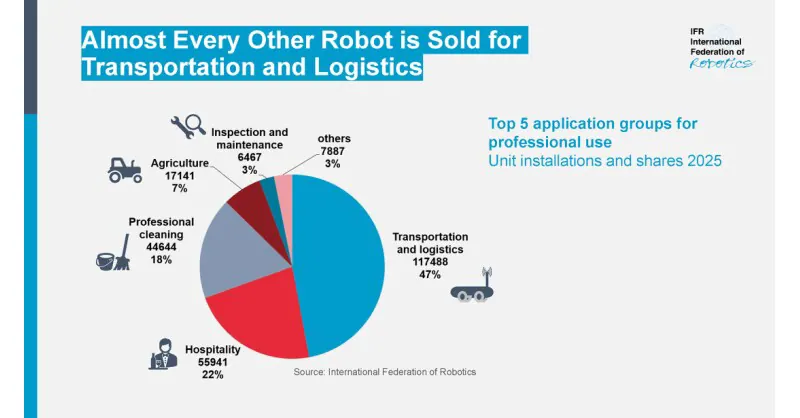
The International Federation of Robotics (IFR) has reported a significant surge in global shipments of professional service robots. In 2025, the industry saw a 24% increase, with almost 250,000 units shipped. This growth highlights a successful shift towards commercial automation. According to Jane Heffner, President of the IFR, service robots are expanding into everyday operations, with sales increasing across all three segments: professional service robots, medical robots, and consumer service robots.
The top application for professional service robots in 2025 was transportation and logistics, with 117,500 units sold. This represents a 21% increase and a market share of 47%. These robots are primarily used for transportation, automation of material flows, and delivery processes. The IFR report also notes that while traditional sales remain the main monetization channel, Robots-as-a-Service (RaaS) business models continue to grow in popularity, particularly in the US.
Hospitality robots ranked second in terms of application, with machines for mobile guidance, information points in public environments, and telepresence accounting for the majority of these robots. The market for professional cleaning robots followed in third place, with floor cleaning as the main application. The growth of professional service robots is driven by advances in robotics, improved efficiency, and increasing demand for automation.
Humanoid robots, designed to resemble humans and operate in human-centric environments, are gaining attention for their potential flexibility. In 2025, about 7,000 units of full-size humanoids (above 140 cm) were sold globally. These robots are intended for commercial and professional applications beyond research and development and entertainment. However, challenges such as safety standards, high training and maintenance costs, and the lack of a strong business case continue to limit widespread adoption.
The IFR report also highlights the growth of consumer service robots, which primarily consist of domestic robots aimed at the mass market. Overall sales of consumer robots increased by 37% to almost 34.2 million units in 2025. Key trends include automating household tasks, integrating artificial intelligence, and connecting to smart home systems.
The medical robotics market saw significant growth in 2025, driven by surgical robots. With 8,400 units sold, the market experienced a growth rate of 57%. This reflects the increasing adoption of surgical robots in clinical practice, driven by advances in robotics, improved clinical outcomes, and growing acceptance among healthcare professionals.
The IFR's World Robotics 2026 Service Robots report provides a comprehensive overview of the service robot market. The report is based on a sample of 238 service robot suppliers and highlights key trends, challenges, and developments in the industry. According to Dr. Werner Kraus, Chair of the IFR Service Robot Committee, the report provides a special chapter on humanoids as the newest market in robotics.
Key points
- Global shipments of professional service robots increased by 24% to almost 250,000 units in 2025.
- Transportation and logistics remained the top application for professional service robots, with 117,500 units sold in 2025.
- Humanoid robots are gaining attention for their potential flexibility, with 7,000 units of full-size humanoids sold globally in 2025.