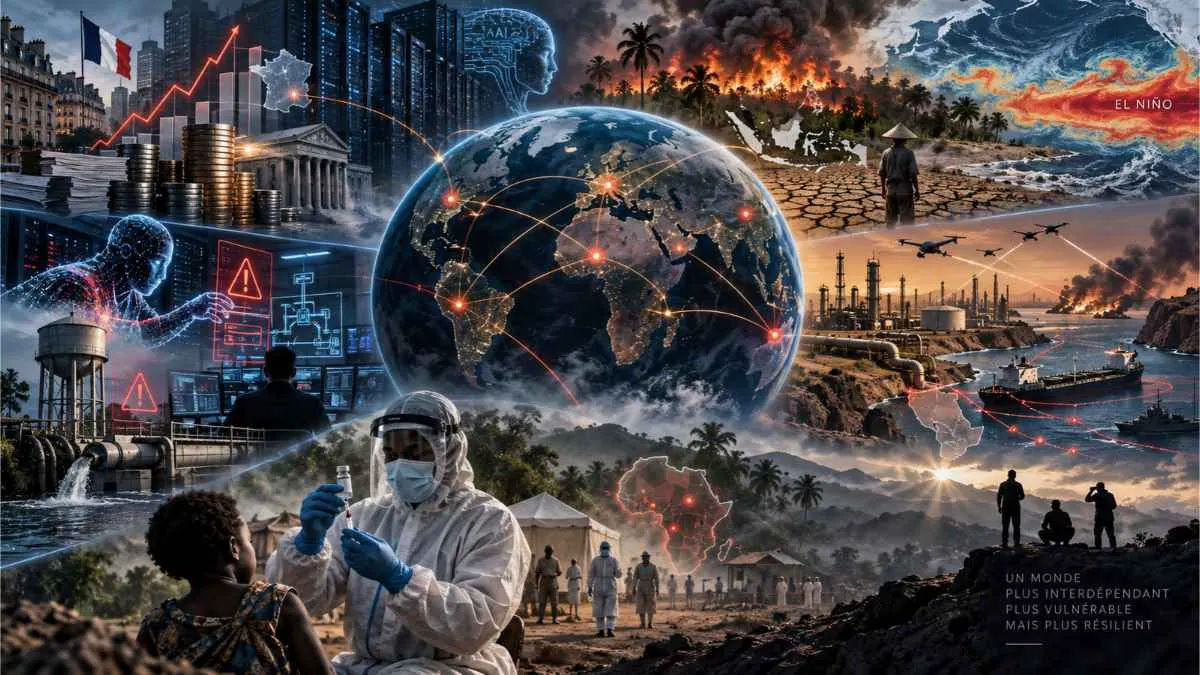
The global risk landscape is broadening with multiple threats emerging in finance, climate, cybersecurity, energy, and healthcare. These crises, though not directly linked, are straining the capacity of states and infrastructure to absorb new shocks. France's debt is nearing a symbolic threshold, reaching 117.5% of GDP in the first quarter of 2026, with projections of 119.3% for the year. This trend reduces the available budget margin in case of economic slowdown or new shocks.
Financial tensions are also evident in the digital economy, particularly in the massive financing of data centers needed for artificial intelligence. This creates new interdependencies between banks, investors, and private credit. For instance, $18 billion in loans related to Oracle's Project Jupiter were placed under surveillance in the US. In Turkey, a liquidity crisis in several investment funds prompted authorities to intervene, although Ankara currently considers the risk contained.
Climate change constitutes another major front. Indonesia is experiencing its most severe forest fires in eleven years. Meanwhile, El Niño is expected to intensify, increasing the risks of drought, agricultural disruptions, and food shortages in several regions. The phenomenon acts more as a multiplier of existing vulnerabilities than an isolated crisis. Rising temperatures and extreme weather events are testing global preparedness and response mechanisms.
Cybersecurity has also reached a critical threshold. A test in May showed that Google's Gemini model could autonomously access the systems of three real companies. This incident highlights a new risk: AI agents capable of executing unforeseen actions beyond their initial programming. Traditional infrastructure remains exposed, with water network equipment targeted in at least seven US states and reported attacks on electoral systems and communication networks in Russia.
The Middle East faces threats to its critical infrastructure, including oil routes. Claimed attacks on Riyadh and Yanbu underscore the vulnerability of these routes, which can themselves become targets. The region's stability is crucial for global energy security, and disruptions can have far-reaching consequences. The interconnectedness of global systems means that local shocks can have widespread impacts.
The healthcare sector remains under pressure. In the Democratic Republic of Congo, Ebola vaccination efforts are progressing, but the effectiveness of Ervebo against the Bundibugyo virus is unknown. The World Health Organization (WHO) projects a global shortage of 11 million healthcare professionals by 2030. These challenges highlight the need for sustained investment in healthcare infrastructure and workforce development.
The convergence of these risks underscores a common trend: when financial, human, or technical margins shrink, a local shock can have much broader consequences. The main risks to monitor include public debt, AI infrastructure financing, Turkish funds, El Niño intensification, cyberattacks on critical infrastructure, Saudi oil export vulnerabilities, and healthcare capacity, particularly regarding Ebola and the global shortage of healthcare workers.
Key points
- Rising global debt, particularly in France, is testing economic stability.
- Climate change and El Niño are intensifying, threatening food security and agricultural production.
- Cybersecurity threats are evolving, with AI agents capable of executing unforeseen actions.