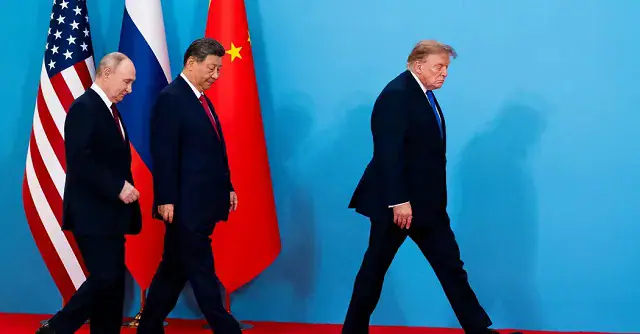
The global landscape of power is undergoing a significant transformation, with the Atlantic's dominance giving way to the Pacific's rising influence. A recent meeting in Shenzhen between Chinese President Xi Jinping, US President Donald Trump, and Russian President Vladimir Putin exemplifies this shift. Notably, no European leaders were present, marking a stark contrast to the 1945 Yalta Conference, where Roosevelt, Churchill, and Stalin shaped the post-war world order. This change signifies a new era in global politics.
For centuries, European capitals have dictated global affairs, drawing maps, naming rivers, and setting borders. The 1884 Berlin Conference, where European diplomats divided Africa without African representation, is a prime example. However, after World War II, Europe was left devastated, and the Marshall Plan and NATO helped rebuild and secure the continent. The 1956 Suez Crisis marked a turning point, as the US told Britain and France to withdraw, effectively ending European colonial empires. Since then, Europe has focused on regulations and diplomacy.
The US initially took the lead in global affairs, producing nearly half the world's output and holding the only atomic bomb. However, the rise of Asia, particularly China, has dramatically altered the landscape. China has become the world's second-largest economy, largest trading nation, and boasts the largest navy by number of ships. Russia, with its significant nuclear power and combat experience, remains a key player. The UN Charter's emphasis on sovereign equality is overshadowed by the reality of power dynamics, where the strong dictate terms.
The current global order is characterized by a concentration of economic, nuclear, and military power in the hands of a few nations. Washington, Beijing, and Moscow hold significant sway, and their interests often take precedence. This realist perspective acknowledges that might makes right, not due to moral justification, but because it is a factual reality. The strong do what they can, and the weak suffer what they must, as Thucydides noted 24 centuries ago.
While other nations, such as the EU, Japan, and India, will maintain their influence, they will not have a seat at the table in the same way as the dominant powers. The world is shifting towards a tripolar order, centered on the Pacific, where the largest economies, busiest ports, and most significant summits are now located. The Atlantic century is coming to an end, and a new era has begun, with much at stake for those who adapt and shape the future.
As the global power dynamics continue to evolve, a pressing question remains: where does Africa fit in this new order? With 54 seats at the UN, abundant natural resources, and a young population, Africa holds significant potential. However, its absence from key discussions, such as the Shenzhen meeting, raises concerns about its role in shaping the future. Will Africa be a participant in the new global order or merely a subject of discussion?
The era of global power shifts is upon us, and Africa must decide how to engage with the changing landscape. To have a seat at the table, Africans must negotiate collectively and strategically. The time has come for Africans to stop asking for a chair and start building their own table, as Michael Ruhindayo Rumanda, an Organisation Development expert, astutely observes. The conversation about Africa's role in the new global order must begin now.
Key points
- The global power dynamics are shifting from the Atlantic to the Pacific, with Europe losing influence.
- The rise of Asia, particularly China, has dramatically altered the global landscape.
- Africa's role in the new global order remains uncertain, with concerns about its participation and representation.
Reporting sources
- From Yalta to Shenzhen: The changing architecture of global power · The Independent magazine