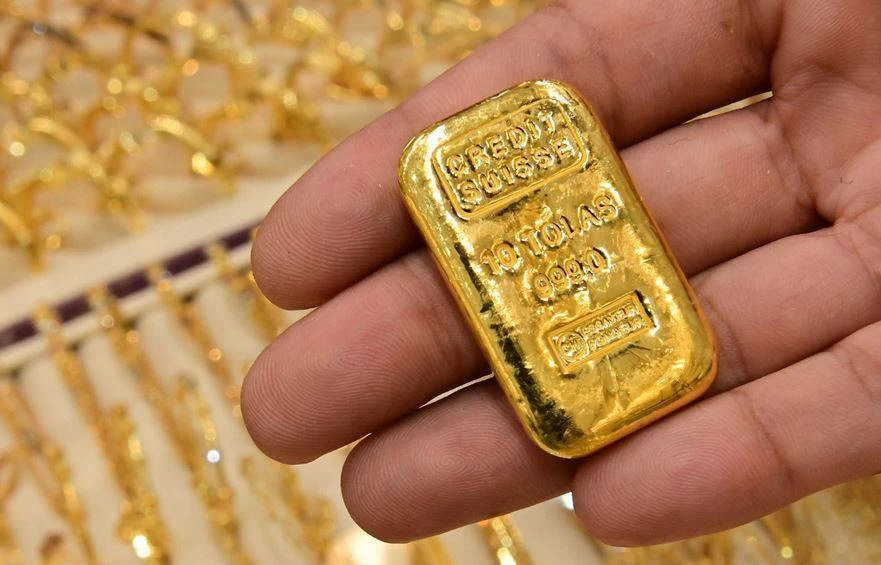
Global gold prices experienced a decline on Friday, heading towards a weekly loss due to concerns about inflation and hawkish signals from US Federal Reserve policymakers. The price of gold in immediate delivery dropped by 0.1% to $4,274.18 per ounce, marking a 2.4% weekly decrease. Conversely, US gold futures rose by 0.3% to $4,310.80. This weekly loss is attributed to rising US Treasury bond yields, which increase the opportunity cost of holding non-yielding gold.
The consistent rise in US Treasury bond yields has placed gold on a path of its fourth weekly decline over the past five weeks. As bond yields surge, the appeal of gold diminishes, as it does not generate interest. Gold faces multiple headwinds, including persistent inflation risks, significantly higher bond yields, and the Federal Reserve's stringent policy stance. Since the onset of the US-Israel conflict with Iran, high energy prices have sustained inflation fears, prompting central banks to adopt more rigid policies to control price pressures.
The Federal Reserve recently increased interest rates by a quarter of a percentage point, its first hike in three years, signaling further increases in the future. Market participants anticipate a 64% likelihood of another rate hike in October and a 93% chance in December, according to the CME FedWatch tool. Gold traditionally serves as a hedge against inflation and a safe investment during geopolitical instability. However, higher interest rates reduce its attractiveness as investors turn to higher-yielding assets.
The price of gold has decreased by about 19% from its peak on February 27. Negotiators in New York are exploring a gradual exit from the conflict, which could involve reopening Iranian access to the Strait of Hormuz and lifting US economic sanctions on Iran. Meanwhile, oil prices dropped by over 1% as some supply concerns eased. Other precious metals also saw declines, with silver down 0.1% to $63.84 per ounce, platinum up 0.4% to $1,755.25, and palladium down 1.6% to $1,252.62.
In Egypt, the local market saw the following prices: gold of 24-karat was priced at 7,131.5 pounds per gram, 21-karat at 6,240 pounds per gram, and 18-karat at 5,348.5 pounds per gram. The price of a gold pound was 49,920 pounds. These prices reflect the fluctuations in the global market and local demand.
The decline in global gold prices and the subsequent impact on the Egyptian market can be attributed to the interplay of various economic factors, including inflation concerns, interest rate hikes, and geopolitical tensions. As investors navigate these changes, the prices of gold and other precious metals continue to adjust.
Moving forward, market participants will closely monitor the Federal Reserve's policy decisions and global economic indicators to gauge the future trajectory of gold prices. The precious metal's role as a safe-haven asset and inflation hedge will continue to be scrutinized in the context of evolving economic and geopolitical landscapes.
Key points
- Global gold prices are down 2.4% weekly due to inflation concerns and US Federal Reserve policies.
- Egyptian market prices for gold have been affected, with 21-karat priced at 6,240 pounds per gram.
- Rising US Treasury bond yields have reduced gold's appeal as a non-yielding asset.